How AI Energy Management Optimises Your Home Battery to Save More Money
A home battery can store cheaper electricity and use it when electricity prices rise. But the battery cannot deliver its full potential simply by sitting on the wall and following the same schedule every day.
AI energy management improves how the battery operates by analysing electricity tariffs, household consumption, predicted demand, battery charge and other relevant information. It then decides when to charge, how much energy to store and when that energy is most valuable to use.
In simple terms:
A battery stores energy. AI energy management decides how to use that storage more intelligently.
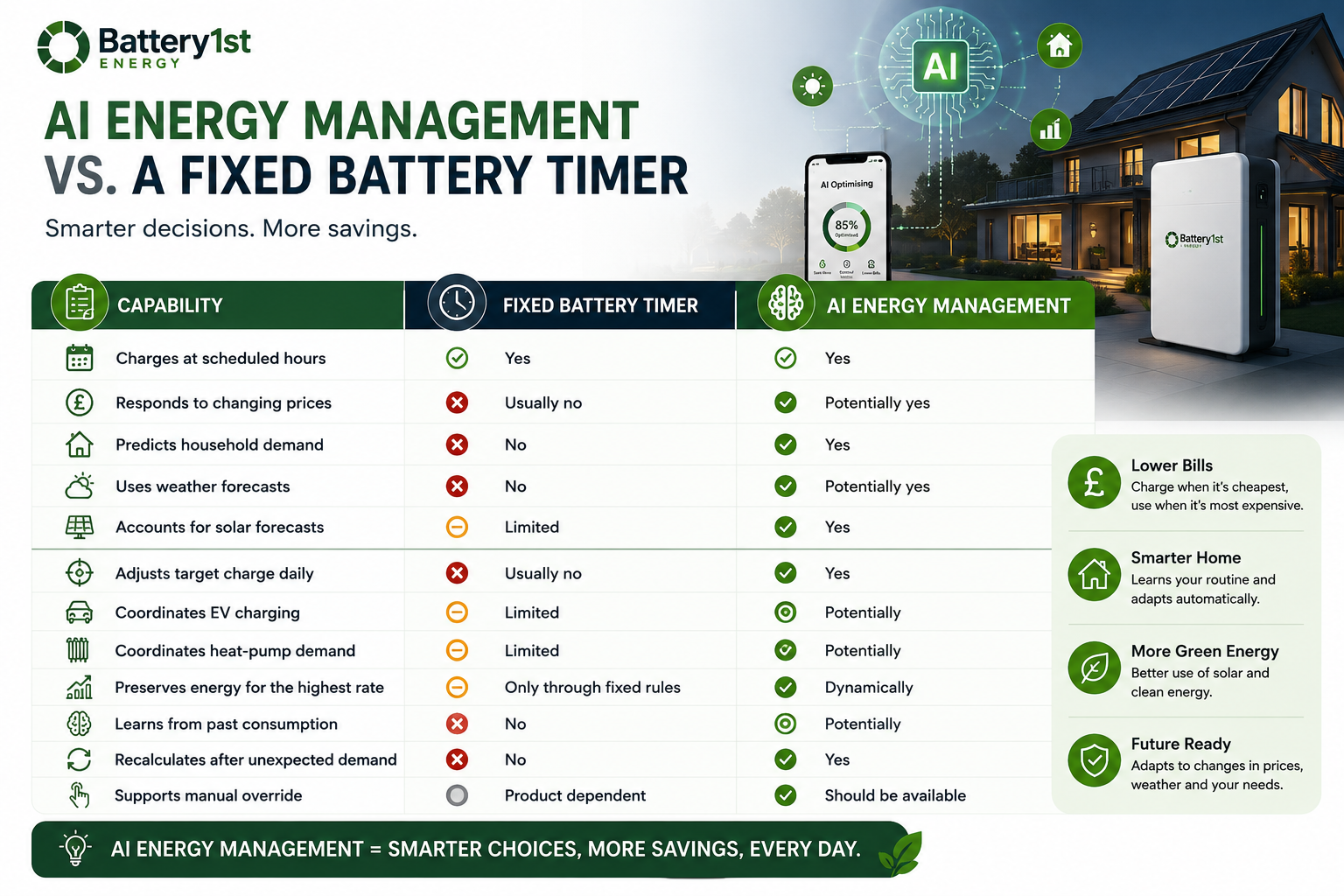
This distinction matters because household demand and electricity prices are not always predictable. A fixed timer may work on a simple tariff, but it cannot always respond effectively to changing prices, changing routines, solar forecasts or additional loads such as an electric vehicle or heat pump.
This guide explains how home energy AI works, how it can support battery savings and what homeowners should check before choosing a smart battery system.
Quick Answer: How Does AI Help a Home Battery Save Money?
AI can help a home battery save money by continuously comparing:
Current and future electricity prices
Expected household consumption
Available battery capacity
Charging and discharge limits
Predicted solar generation
EV or heat-pump requirements
Backup reserve preferences
The smart battery software then creates a charging and discharge plan.
For example, it may charge the battery overnight when electricity is cheaper, preserve stored energy during a moderate-price period and discharge it during a more expensive evening peak.
The objective is to reduce the amount of high-priced electricity purchased directly from the grid.
Actual savings still depend on the tariff, household usage, equipment, installation cost and changing energy prices. AI can improve decision-making, but it cannot guarantee a fixed financial result.
What Is AI Energy Management?
AI energy management is the automated use of data, forecasts and optimisation methods to decide when a home should buy, store, generate and use electricity.
In a battery-equipped home, an energy management system may control or coordinate:
Grid battery charging
Battery discharge
Solar self-consumption
Grid electricity imports
Solar electricity exports
EV charging
Heat-pump operation
Hot-water heating
Backup energy reserves
Participation in flexibility programmes
The term “AI” can cover different technical approaches. Depending on the platform, it may include:
Forecasting models
Machine learning
Rules-based logic
Mathematical optimisation
Price prediction
Consumption prediction
Automated scheduling
Continuous performance adjustment
Not every product marketed as “AI-powered” uses the same methods or provides the same capabilities. Homeowners should therefore evaluate what the software actually does rather than relying on the label alone.
What does home energy AI optimise?
A home energy AI platform normally tries to achieve one or more objectives, such as:
Reducing electricity costs
Avoiding peak-rate grid imports
Increasing solar self-consumption
Maintaining backup capacity
Charging an EV by a required departure time
Coordinating a heat pump with cheaper tariffs
Reducing unnecessary battery cycling
Responding to electricity-system flexibility events
Balancing financial savings with household comfort
The correct objective depends on the homeowner’s priorities.
Why Does a Home Battery Need Intelligent Control?
A battery has limited storage capacity. Once it is full, it cannot store more electricity. Once it reaches its minimum reserve, it cannot continue supplying the home.
Every charging decision therefore has an opportunity cost.
If the battery charges too early, it may buy electricity at a higher price than necessary.
If it discharges too early, it may have insufficient energy left for the most expensive part of the day.
If it charges too much, the household may pay for energy it does not need.
If it charges too little, the home may return to expensive grid electricity before the peak period ends.
A battery must answer several questions every day
An effective control system needs to determine:
How much energy will the household probably use?
When will that energy be needed?
When will grid electricity be cheapest?
When will grid electricity be most expensive?
How much charge is already available?
How quickly can the battery charge?
How much power can it deliver?
Is solar generation expected?
Does the homeowner want backup power?
Will an EV or heat pump create additional demand?
A fixed charging timer answers only one of these questions: when charging should start and stop.
AI energy management can consider the wider picture.
How AI Optimises a Home Battery
AI-based energy optimisation normally follows a repeated process: collect data, predict future conditions, create a plan, operate the battery and review the result.
1. It reads current system conditions
The software may begin by checking:
Battery state of charge
Current household consumption
Current grid import
Live solar generation
Current tariff rate
Inverter status
Connected-device availability
Backup reserve setting
This gives the system a real-time view of the home.
2. It predicts future household demand
The platform may use historical consumption to estimate how much electricity the home is likely to need during the next several hours or day.
The forecast may identify patterns such as:
Higher weekday morning demand
Evening cooking periods
Lower consumption when the household is away
Increased weekend appliance use
Seasonal heating demand
Regular EV charging
Heat-pump operation during cold weather
A useful forecast does not need to predict every appliance perfectly. It needs to be accurate enough to improve the battery schedule compared with a simple fixed rule.
3. It evaluates electricity prices
On a static time-of-use tariff, the software can use predetermined peak and off-peak periods.
On a dynamic tariff, prices can change more frequently. The software may need to evaluate several possible charging windows and identify the periods that provide the strongest economic opportunity.
Energy Saving Trust explains that smart time-of-use tariffs charge different prices at peak, shoulder and off-peak times. Dynamic tariffs may change their prices daily in response to wholesale market conditions.
4. It forecasts available solar energy
Where solar panels are installed, the platform can consider:
Weather forecasts
Expected cloud cover
Season
Historical system output
Panel orientation
Recent generation performance
If strong solar generation is expected, the software may leave empty battery capacity available rather than filling the battery completely from the grid overnight.
If poor weather is expected, it may purchase more off-peak electricity to prepare for higher grid demand.
5. It respects system constraints
Battery automation must operate within physical and contractual limits.
These may include:
Usable battery capacity
Maximum charging power
Maximum discharge power
Minimum state of charge
Inverter limits
Grid connection limits
Export restrictions
Battery temperature
Warranty conditions
EV departure requirements
Homeowner comfort settings
Good energy optimisation does not simply choose the theoretically cheapest plan. It chooses the lowest-cost feasible plan within these constraints.
6. It creates a charging and discharge schedule
The system uses the available information to decide:
When charging should begin
How much electricity to purchase
What target state of charge to use
When the battery should discharge
When grid electricity should be used directly
Whether solar energy should be stored or exported
How much battery capacity should remain in reserve
The schedule may cover the next day or shorter rolling periods.
7. It adjusts when conditions change
A forecast is never perfect.
The household may use more electricity than expected. Weather conditions may change. An EV may be connected earlier than usual. Electricity prices may be updated.
Smart battery software can recalculate the plan when new information becomes available.
This continuous adjustment is one of the main differences between intelligent charging and a basic timer.
What Information Does Home Energy AI Use?
The quality of AI energy management depends on the relevance, availability and accuracy of its data.
Smart-meter consumption data
A smart meter can record electricity consumption in half-hourly intervals. This allows the platform to identify when the household normally uses energy rather than relying only on total annual consumption. Ofgem confirms that smart meters store half-hourly usage information and can support access to a wider range of smart tariffs.
Useful patterns may include:
Morning demand
Evening peaks
Overnight base load
Weekday and weekend differences
Seasonal changes
Responses to previous tariff periods
Tariff data
The platform needs accurate information about:
Import rates
Peak periods
Off-peak periods
Dynamic half-hourly prices
Export rates
Standing charges where relevant
Tariff eligibility
Flexibility-event rewards
Without reliable tariff data, intelligent charging may operate at the wrong times.
Battery data
The system may monitor:
Current state of charge
Usable capacity
Charging power
Discharge power
Minimum reserve
Temperature
Battery efficiency
Battery health
Fault conditions
Weather forecasts
Weather information becomes particularly important when the property has:
Solar panels
A heat pump
Electric heating
Temperature-sensitive demand
A cold forecast may indicate increased heating demand. A sunny forecast may indicate that solar generation can fill the battery later.
Connected-device data
An integrated platform may also receive information from:
EV chargers
Heat pumps
Solar inverters
Hot-water controllers
Smart thermostats
Other flexible electrical loads
The more devices that can coordinate safely, the more options the system has for energy optimisation.
Homeowner preferences
Financial optimisation should not ignore human requirements.
The homeowner may set preferences for:
Minimum backup reserve
EV departure time
Required EV charge
Indoor temperature
Quiet operating periods
Maximum grid charging
Solar export preferences
Manual overrides
The system should optimise around these preferences rather than making the home inconvenient to operate.
AI Energy Management Versus a Fixed Battery Timer
When can a timer be sufficient?
A timer may be adequate when:
The tariff has one fixed cheap period
Household consumption is highly predictable
There are no solar panels
There is no EV or heat pump
The battery is large enough to cover normal demand
The homeowner is willing to adjust settings manually
When is intelligent charging more useful?
AI energy management becomes more valuable when:
Electricity prices change frequently
Household consumption varies
Solar generation is unpredictable
Battery capacity is limited
A heat pump creates weather-sensitive demand
An EV must charge by a deadline
The homeowner wants a backup reserve
Import and export prices must be compared
Several energy devices need coordination
How AI Energy Management Can Improve Battery Savings
AI does not create savings by itself. It improves the decisions that determine when electricity is purchased and used.
AI energy management can avoid unnecessary charging
A basic system may charge to 100% every night.
That may be inefficient when:
The household will be empty
Solar generation is expected
The battery already contains sufficient energy
The price difference is too small
Future demand is unusually low
Home energy AI can select a lower charge target when a full battery is unlikely to be needed.
AI energy management can preserve energy for the highest prices
Suppose a tariff has:
Cheap overnight electricity
A moderate afternoon rate
A high evening peak
A basic self-consumption setting might begin discharging as soon as the cheap period ends. This could leave too little stored energy for the evening peak.
Intelligent charging can preserve battery capacity during the moderate-rate period and prioritise discharge when avoided grid electricity is most valuable.
AI energy management can use changing tariffs
On a dynamic tariff, tomorrow’s lowest-priced hours may be different from today’s.
Battery automation can:
Import the upcoming price schedule
Rank potential charging periods
Include efficiency losses
Forecast required energy
Choose the most economical feasible schedule
Update the plan when prices change
AI energy management can prepare for unexpected demand
If the software predicts that the household will use more electricity than usual, it can increase the battery’s target charge.
Examples include:
A colder day requiring more heating
An EV arriving with a low charge
Guests increasing household demand
Weekend appliance use
Reduced expected solar output
AI energy management can reduce avoidable peak imports
A battery may still import grid electricity when:
It is empty
Its output power is too low
The control system discharged it too early
The battery was not charged sufficiently
A backup reserve is being protected
Software cannot correct inadequate hardware, but it can reduce peak imports caused by poor scheduling.
A Practical Intelligent-Charging Example
Consider a household with:
A 10kWh nominal home battery
9kWh of usable capacity
A five-hour cheap overnight tariff
A higher evening rate
Solar panels
Average evening demand of 6kWh
A 20% backup reserve
Scenario A: Fixed charging
The battery charges fully every night.
The next day is sunny, and household demand is low. Because the battery is already full, surplus solar electricity cannot be stored and may be exported.
The household paid for overnight grid electricity that was not required.
Scenario B: AI energy management
The software reviews:
The battery’s existing charge
Tomorrow’s solar forecast
Expected household consumption
The overnight rate
The evening peak rate
The required backup reserve
It predicts that solar generation will provide most of the required energy. The battery therefore charges only to 45% overnight.
During the day, surplus solar fills the remaining capacity. The stored energy is preserved for the evening peak.
Potential benefit
The AI-controlled plan may:
Buy less overnight electricity
Store more surplus solar
Maintain the required reserve
Reduce evening grid imports
Increase the economic value of the battery cycle
The exact financial result will depend on the property’s real tariff, consumption and generation.
Illustrative Battery Savings Calculation
The following example uses hypothetical rates. It is not a supplier quote or savings guarantee.
Assume:
Off-peak electricity rate: 10p per kWh
Peak electricity rate: 30p per kWh
Battery round-trip efficiency: 90%
Stored electricity delivered to the home: 7kWh
Cost of charging
The battery needs more than 7kWh of imported energy because some electricity is lost during charging and discharge.
7kWh ÷ 0.90 = 7.78kWh
7.78kWh × £0.10 = approximately £0.78
Peak electricity avoided
7kWh × £0.30 = £2.10
Illustrative gross daily tariff saving
£2.10 − £0.78 = £1.32
The gross saving assumes all 7kWh replaces electricity that would otherwise have been purchased at 30p per kWh.
Now suppose a poorly configured schedule uses 2kWh of that energy during a 17p shoulder period instead of preserving it for the 30p peak.
The economic value of those 2kWh falls.
AI energy management may improve the result by assigning the battery’s limited capacity to the periods with the highest avoided cost.
This example excludes:
Battery purchase and installation cost
Finance costs
Standing charges
Battery degradation
Inverter consumption
Maintenance
Tariff changes
Export income
Flexibility rewards
Taxes and contract fees
Energy Saving Trust confirms that batteries can charge when tariffs are cheap and discharge when electricity prices are high, but also warns that storage losses and upfront costs affect the overall financial case.
How AI Works With Time-of-Use Tariffs
A time-of-use tariff charges different electricity rates at different times.
Static time-of-use tariffs
Static tariffs normally use predetermined price periods.
For example:
Off-peak: 12am–5am
Standard: 5am–4pm
Peak: 4pm–7pm
Standard: 7pm–12am
These times are illustrative.
AI energy management can still add value by changing the target charge according to expected demand and solar generation, even when the tariff schedule remains fixed.
Dynamic tariffs
Dynamic tariffs may publish different prices for each half-hour period.
The lowest-cost charging window may therefore consist of several non-consecutive periods.
Smart battery software can evaluate whether it is better to:
Charge continuously
Split charging across several periods
Avoid a short price spike
Leave capacity for expected solar
Charge extra before a high-price event
Energy Saving Trust notes that dynamic tariffs set prices closer to real-time electricity consumption and may occasionally include negative pricing.
Effective charging cost matters
The software should not compare the import rates alone.
Because battery storage involves losses, the effective cost of delivered electricity is:
Effective stored electricity cost = charging rate ÷ round-trip efficiency
For example:
10p ÷ 90% = approximately 11.1p per delivered kWh
Charging at 10p to avoid electricity costing 12p may produce little value after accounting for losses.
Charging at 10p to avoid electricity costing 30p creates a wider potential margin.
How AI Works With Solar, EVs and Heat Pumps
A future-ready energy platform should be able to coordinate several household technologies rather than optimising each device in isolation.
AI Energy Management With Solar Panels
Solar generation introduces an important decision:
Should the battery charge from the grid now, or leave capacity for free solar generation later?
The answer depends on:
Expected solar production
Current battery charge
Expected household demand
Import rates
Export rates
Battery efficiency
Evening consumption
On a sunny day
The system may:
Limit overnight grid charging
Leave battery capacity available
Use live solar in the home
Store surplus generation
Preserve stored energy for the evening
Export only when appropriate
On a cloudy day
The system may:
Increase overnight grid charging
Maintain a higher morning state of charge
Expect lower solar input
Reduce exposure to peak import rates
AI Energy Management With an EV
An EV and home battery may compete for the same cheap electricity window.
The software must consider:
EV battery level
Required driving range
Departure time
EV charger power
Home battery charging power
Property supply capacity
Household overnight load
Tariff-window duration
A sensible plan may charge the EV directly from the grid during the off-peak period while charging the home battery enough to cover household demand after the low-cost window closes.
The home battery does not necessarily need to charge the EV itself. Direct off-peak EV charging may avoid additional conversion losses and unnecessary home-battery cycling.
AI Energy Management With a Heat Pump
Heat-pump electricity demand changes with:
Outdoor temperature
Property heat loss
Flow temperature
Hot-water requirements
Occupancy
Heating schedule
Home energy AI may use weather and demand forecasts to prepare the battery for a colder day.
It may also coordinate:
Off-peak battery charging
Strategic pre-heating
Hot-water production
Battery discharge during high-priced periods
Minimum comfort requirements
The control system should never sacrifice essential comfort or safety merely to reduce electricity costs.
Can AI Protect Battery Health?
AI energy management may support battery health by operating within manufacturer limits and avoiding unnecessary behaviour.
Potential battery-health controls include:
Maintaining a minimum state of charge
Avoiding excessive charging or discharge power
Limiting operation at unsuitable temperatures
Reducing unnecessary full cycles
Avoiding repeated deep discharge
Preserving manufacturer-required reserves
Responding to fault or temperature warnings
Energy Saving Trust explains that battery systems normally stop discharging at a protected minimum level rather than reaching zero because full depletion can shorten battery life. It estimates a typical home battery lifespan of approximately 10–12 years, although the actual result depends on the product and its operation.
Battery savings versus battery wear
The cheapest immediate charging strategy is not always the best lifetime strategy.
The software may need to compare:
The value of completing another battery cycle
The tariff saving from that cycle
Conversion losses
Battery degradation
Warranty throughput limits
Future energy requirements
Homeowners should ask whether the platform considers battery degradation or simply maximises short-term tariff differences.
Can AI Energy Management Support Grid Flexibility?
A connected battery may be able to change its operation when the electricity system needs support.
Depending on the provider, programme and eligibility, the battery may:
Reduce grid imports during busy periods
Delay charging
Charge when excess electricity is available
Export stored energy where permitted
Participate through an approved supplier or aggregator
The National Energy System Operator’s Demand Flexibility Service rewards eligible households and businesses for changing when they use electricity. Since April 2026, eligible participants may be rewarded for reducing demand at busy times or increasing use when that helps balance the system. Participation depends on the registered provider, a working smart meter and the rules of each event.
Any flexibility income should be treated as a possible additional benefit, not a guaranteed part of the battery savings calculation.
What AI Energy Management Cannot Guarantee
AI can improve decisions, but it cannot remove every limitation.
It cannot guarantee a fixed saving
Battery savings depend on:
Future electricity tariffs
Household consumption
Weather
Equipment performance
Battery degradation
Installation costs
Changing supplier terms
Software availability
User preferences
A provider should explain assumptions and provide a range rather than an unconditional savings promise.
It cannot compensate for an undersized battery
If the battery does not have enough usable capacity, software cannot make it supply more energy than it stores.
It cannot overcome inadequate inverter power
If household demand exceeds the battery inverter’s output, the home may import electricity from the grid even when stored energy remains.
It cannot predict behaviour perfectly
Unexpected appliance use, guests, travel, weather changes and EV journeys can make demand forecasts inaccurate.
A good system should respond to forecast errors rather than claiming to eliminate them.
It cannot make every tariff suitable
A tariff with a narrow difference between charging and avoided rates may offer limited savings after battery losses.
It cannot replace good installation design
The battery, inverter, cabling, consumer unit, grid connection and software must work as one system.
Smart software cannot correct fundamental installation defects.
It should not remove homeowner control
Homeowners should be able to understand:
What the system is doing
Why it is charging
Why it is discharging
What reserve is protected
How to change priorities
How to use a manual override
Automation should make the system easier to operate—not make its decisions impossible to inspect.
Data Privacy and Cybersecurity Questions
Smart battery software may process detailed household information.
Depending on the platform, this could include:
Half-hourly energy use
Device operating schedules
EV charging times
Solar production
Battery status
Occupancy-related patterns
Tariff and account information
Homeowners should ask:
What data is collected?
Why is each data type required?
Where is the data stored?
How long is it retained?
Is it shared with third parties?
Can the homeowner withdraw access?
Is information encrypted?
Does the system use multi-factor authentication?
What happens if internet connectivity is lost?
Can the battery continue operating safely offline?
How are software updates delivered?
Who has remote-control access?
Ofgem explains that consumers have choices concerning how smart-meter data is used beyond billing and other regulated purposes. Permission may allow suppliers or third parties to use the data for services such as tariff recommendations.
What to Look for in Smart Battery Software
Not every platform offers the same level of battery automation.
Essential capabilities
A strong system should ideally provide:
Automatic tariff scheduling
State-of-charge monitoring
Import and export tracking
Clear savings reporting
Manual override
Backup reserve controls
Fault notifications
Secure remote updates
Historical performance data
Safe fallback operation
Advanced energy optimisation capabilities
More advanced smart battery software may provide:
Dynamic tariff integration
Household demand forecasting
Solar generation forecasting
Weather-responsive scheduling
EV charger coordination
Heat-pump coordination
Export-price optimisation
Flexibility-service integration
Continuous schedule recalculation
Multi-device energy orchestration
Questions about savings reporting
Ask whether the displayed “savings” figure includes:
Charging cost
Battery losses
Export income
Standing charges
Installation cost
Finance payments
Battery degradation
Flexibility rewards
Comparison tariff assumptions
A dashboard that counts only the value of avoided peak electricity may overstate the net financial result if it ignores the cost of charging the battery.
How Battery 1st Energy Uses AI-Led Optimisation
Battery 1st Energy helps homeowners begin with a smart battery rather than requiring solar panels as the first step.
The battery stores cheaper off-peak electricity and powers the home when electricity prices are higher. The company’s AI-led energy management is designed to continuously optimise charging and usage to improve potential savings.
The battery-first approach can help a homeowner:
Start shifting electricity costs without waiting for solar
Automate off-peak battery charging
Reduce exposure to higher tariff periods
Adapt charging to household demand
Prepare for solar panels later
Coordinate future EV charging
Integrate a future heat pump
Build a more flexible home energy system
The system’s financial suitability still needs to be assessed using the property’s actual electricity use, available tariffs and equipment requirements.
Questions to Ask a Battery Provider
Before choosing an AI-controlled home battery, ask:
What does your AI energy management actually optimise?
Does it use forecasting, fixed rules or both?
Which tariffs can the software integrate with?
Can it process dynamic half-hourly prices?
Does it use my historical consumption data?
Does it forecast solar generation?
Can it coordinate an EV charger?
Can it account for heat-pump demand?
Does it include battery losses in savings estimates?
Does it consider battery degradation?
Can I set a minimum backup reserve?
Can I override the automatic schedule?
What happens if the internet connection fails?
Can the battery still operate safely offline?
How are software updates managed?
What personal data is collected?
Who can access my system remotely?
How is my information protected?
Can I export my historical energy data?
Are projected battery savings guaranteed or illustrative?
What assumptions were used in the financial model?
Can solar, an EV charger or a heat pump be added later?
Are software features included permanently or subscription-based?
What support is available if optimisation stops working?
A credible provider should answer these questions clearly and explain both the system’s capabilities and its limitations.
Practical Checklist for Homeowners
Before relying on battery automation, confirm:
My smart meter is operating correctly.
My tariff rates and time periods are accurate.
The software knows my battery’s usable capacity.
Charging and discharge limits are configured correctly.
Battery efficiency is included in financial calculations.
My minimum backup reserve is set.
My expected solar generation is considered.
My EV charging deadline is configured where applicable.
My heat-pump requirements are considered where applicable.
I can see why the battery is charging or discharging.
I can override the automatic plan.
The system has a safe offline mode.
I understand how my data is used.
Savings reports use a fair comparison.
I review performance after changing tariffs.
Frequently Asked Questions
1. What is AI energy management?
AI energy management uses household consumption data, electricity tariffs, forecasts and equipment information to automate when energy is bought, stored and used. Its purpose is to improve cost, efficiency or flexibility while respecting system limits and homeowner preferences.
2. How does AI control a home battery?
AI predicts household demand and evaluates future electricity prices, battery charge, solar generation and connected devices. It then creates and updates a schedule for charging, storing and discharging electricity.
3. Can AI energy management reduce electricity bills?
It can improve the timing of battery charging and usage, which may reduce expensive grid imports. Actual savings depend on the tariff difference, electricity consumption, battery efficiency, system size and installation cost.
4. Is AI battery software better than a timer?
It can be better when tariffs, demand or solar generation change regularly. A timer follows fixed hours, while AI software can adjust the charging target and schedule according to predicted conditions.
5. Does home energy AI need a smart meter?
A compatible smart meter is normally needed for modern time-of-use tariffs and provides detailed consumption information. The exact requirements depend on the tariff, software platform and energy supplier.
6. Can AI charge a battery when electricity is cheapest?
Yes, when the software has access to accurate tariff data and compatible battery controls. On dynamic tariffs, it may compare multiple price periods and select the most economical feasible charging window.
7. Can AI manage solar panels, an EV and a heat pump?
A compatible integrated platform may coordinate all three. It can forecast solar output, schedule EV charging and prepare for heat-pump demand while respecting tariff windows and electrical-system limits.
8. Are AI battery savings guaranteed?
No. Savings depend on future energy prices, household behaviour, weather, system efficiency, equipment performance and installation costs. Any projection should clearly state its assumptions.
Conclusion
A home battery creates the ability to store electricity, but AI energy management determines how intelligently that capacity is used.
Instead of following the same schedule every day, smart battery software can assess:
Electricity prices
Household demand
Battery state of charge
Solar forecasts
EV charging needs
Heat-pump demand
Backup preferences
System limitations
It can then charge during lower-cost periods, preserve energy for higher-priced hours and adjust its plan when circumstances change.
This can support stronger battery savings, particularly for homes using time-of-use tariffs or combining several electrical technologies. However, AI does not guarantee a fixed financial return. The battery must still be sized correctly, installed professionally and assessed against the household’s real consumption and available tariffs.
Battery 1st Energy uses a battery-first approach to help homeowners start reducing electricity costs without needing to install solar panels first. Its AI-led controls optimise charging and usage while keeping the system ready for future solar panels, EV charging or a heat pump.
Explore whether an intelligently managed home battery could suit your electricity use by completing the Battery 1st Energy home qualification assessment.
