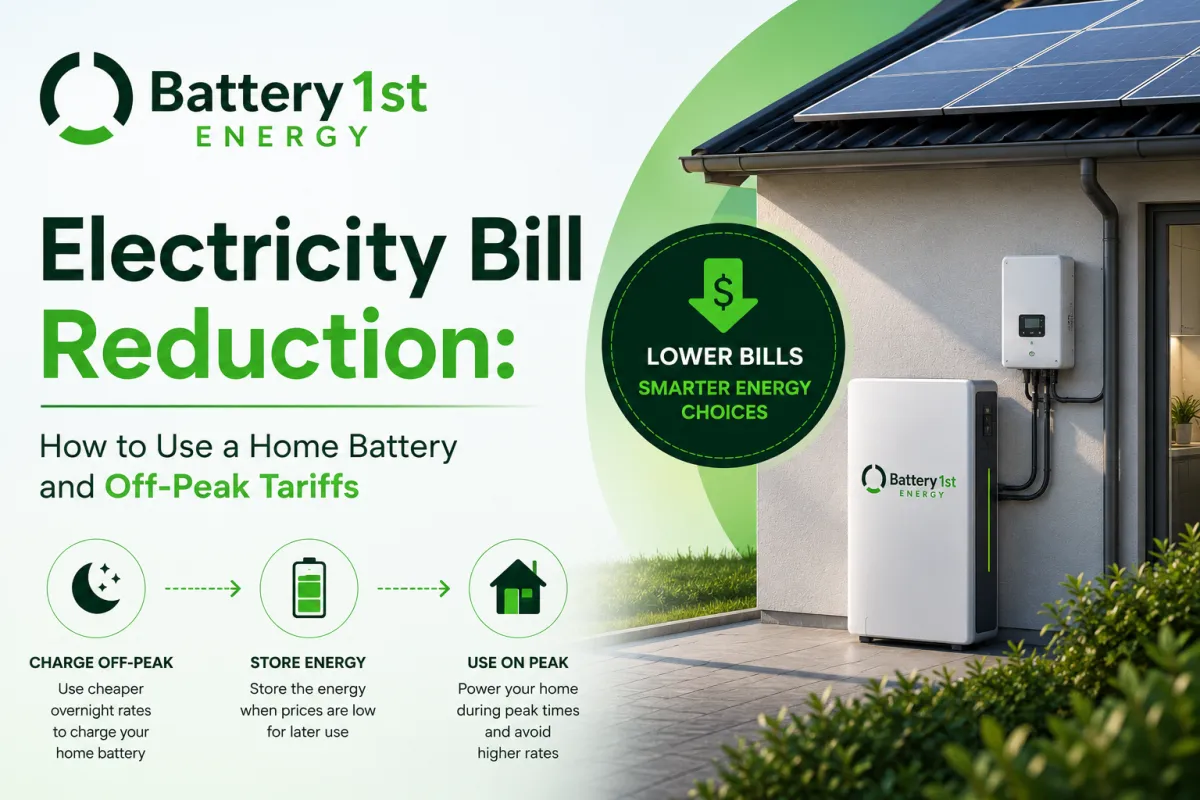
Electricity Bill Reduction: How to Use a Home Battery and Off-Peak Tariffs
Electricity prices do not always stay the same throughout the day. On the right tariff, electricity may cost less overnight or during other low-demand periods and more when demand is high.
A home battery can take advantage of that difference. It charges using cheaper electricity, stores the energy and supplies it to your home later when grid electricity is more expensive. This creates a practical route to electricity bill reduction, even if you do not currently have solar panels.
The basic strategy is simple:
Buy electricity when it is cheaper, store it and use it when electricity is more expensive.
However, meaningful energy savings depend on more than installing any battery and choosing any off-peak tariff. Your electricity consumption, tariff structure, battery size, charging window, system efficiency and control software must work together.
This guide explains how the process works, how to estimate potential savings and what homeowners should evaluate before investing.
How Can a Home Battery Reduce Electricity Bills?
A home battery reduces electricity costs by changing when your home buys energy from the grid.
Without a battery, your home normally buys electricity at the moment you need it. That means you may be cooking, heating water, running appliances or charging devices when electricity rates are at their highest.
With a properly configured battery system, the process can change:
The battery charges during a cheaper off-peak period.
The stored electricity remains available for later use.
The battery supplies your home when grid rates increase.
Your home imports less expensive electricity during peak hours.
The system repeats the process according to your tariff and consumption pattern.
Energy Saving Trust confirms that a battery can be charged from the grid when a smart time-of-use tariff is cheap and then used when electricity prices are higher. It also confirms that a home battery can operate without solar panels.
A direct definition
Home battery electricity bill reduction is the process of storing lower-cost electricity and using it later to avoid purchasing as much higher-cost electricity from the grid.
The financial benefit comes from the difference between:
The cost of charging the battery
The value of the expensive electricity that the stored energy replaces
This difference is sometimes called the tariff spread.
What changes on your electricity bill?
A battery can reduce the amount you spend on electricity units by moving more of your grid consumption into cheap electricity tariff periods.
It will not normally eliminate every bill component. For example, the standing charge is separate from the unit rate and generally remains payable while the property is connected to the electricity network.
What Is a Time-of-Use Tariff?
A time-of-use tariff charges different electricity rates at different times.
Instead of paying one unit rate throughout the day, you may have:
A low off-peak rate
A normal or intermediate rate
A higher peak rate
Energy Saving Trust describes smart time-of-use tariffs as pricing structures in which the cost of electricity varies according to the time it is used. A compatible smart meter is generally required because it records electricity consumption at regular intervals.
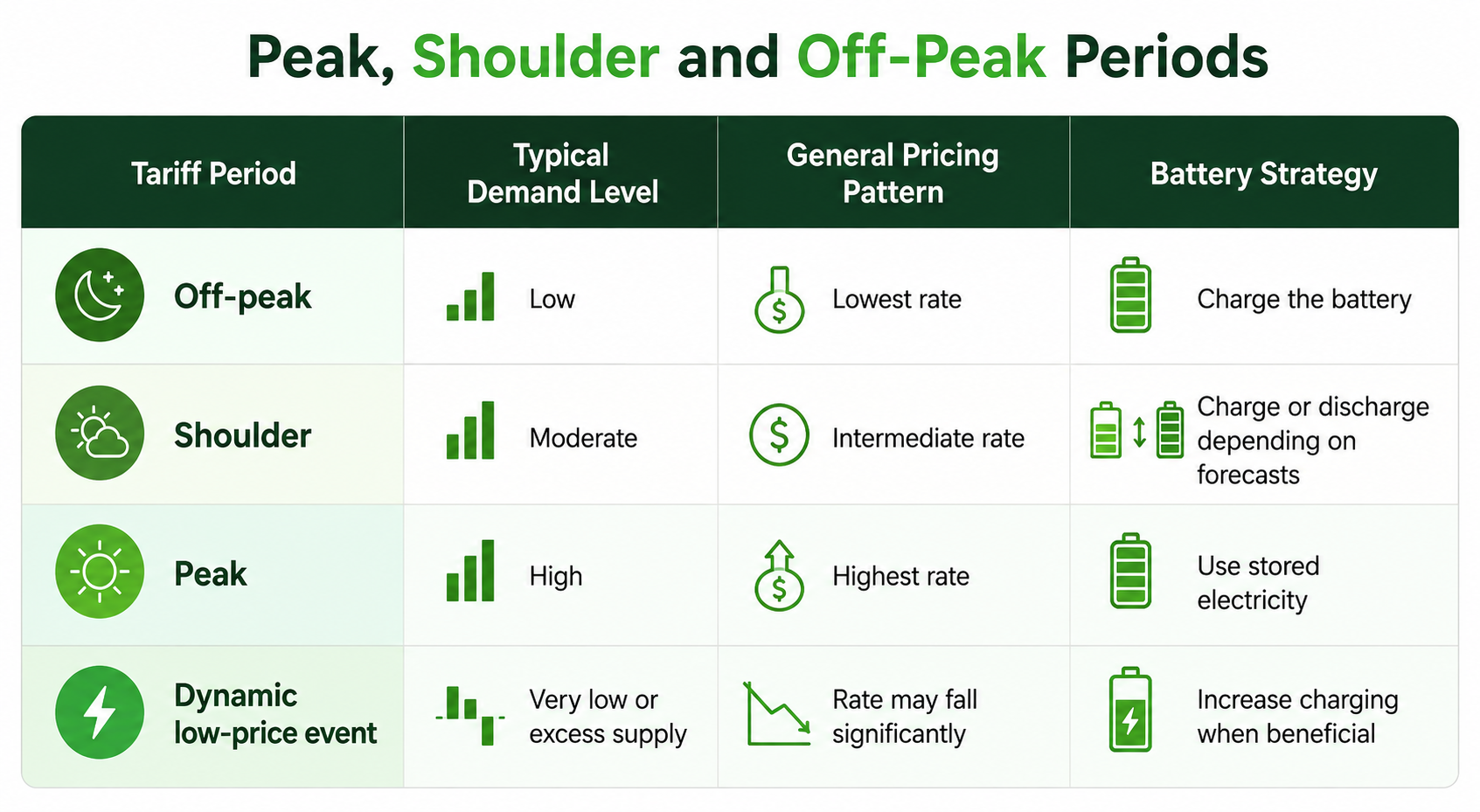
Actual times and rates vary by supplier, tariff, meter configuration, region and contract. Never assume that every supplier defines “off-peak” as the same overnight period. Citizens Advice specifically recommends checking the exact hours because off-peak windows differ between suppliers.
Static time-of-use tariffs
A static tariff has predetermined rate periods.
For example:
Lower rate from midnight to 5:00am
Standard rate during most of the day
Higher rate during an evening peak
The times may remain consistent for weeks or months, making battery charging relatively easy to schedule.
Dynamic time-of-use tariffs
A dynamic tariff can change rates daily or at shorter intervals, often in response to wholesale electricity prices and grid conditions.
These tariffs may create stronger saving opportunities, but they also require more active management. Automated battery controls can be particularly useful because the system may need to respond to changing prices rather than following one fixed charging schedule.
Energy Saving Trust notes that dynamic tariffs can vary by time and day, while static tariffs normally use regular, predetermined time blocks.
How Off-Peak Battery Charging Works
Off-peak charging is the process of importing electricity from the grid during a lower-priced tariff window and storing it in a home battery.
The stored energy is then discharged later, usually when electricity is more expensive.
Step 1: The smart meter records when electricity is imported
A smart meter measures how much electricity your home imports during each tariff period.
This allows the supplier to apply the appropriate off-peak, standard or peak unit rate.
Step 2: The battery charges during the cheapest suitable period
The battery control system schedules charging during the available low-cost window.
For example, it may charge between 12:30am and 5:30am if that is when the tariff offers its lowest rate.
The battery must have enough charging power to store the required energy before the cheap window ends.
Step 3: The battery waits until stored power is valuable
Once charged, the battery holds the electricity until it is needed.
A basic system may begin discharging at a fixed time. A more advanced smart energy system may evaluate:
Current household demand
Remaining battery charge
Current and future electricity prices
Expected weather
Expected solar generation
Peak tariff periods
Future EV or heat-pump demand
Backup reserve requirements
Step 4: The home uses stored electricity
When household demand rises, the battery supplies some or all of the required power.
This reduces the amount of higher-priced electricity imported directly from the grid.
Step 5: The system prepares for the next charging cycle
The battery management system determines how much energy should remain available and when the next charging period should begin.
A well-designed strategy does not simply charge the battery to 100% every night. It considers how much electricity the household is likely to use and whether charging more energy is financially worthwhile.
How Much Could a Home Battery Save?
There is no responsible fixed answer for every household.
Potential electricity bill reduction depends on:
The difference between off-peak and peak rates
How much energy can be shifted
Battery charging and discharging losses
Household usage during expensive periods
Battery capacity and power output
Seasonal consumption
Tariff changes
System settings
Battery purchase and installation costs
Energy Saving Trust states that battery savings can be significant, but they may not always be sufficient on their own to justify the battery’s upfront cost.
A simple savings formula
A useful starting formula is:
Daily avoided peak cost − daily charging cost = estimated daily tariff saving
A more accurate version is:
Energy delivered × peak rate − energy required for charging × off-peak rate = estimated daily saving
Because a battery loses some energy during charging, storage and discharge, the amount purchased during off-peak hours will be slightly higher than the amount delivered to the home.
Illustrative electricity bill reduction example
Assume a household has:
8kWh of electricity demand that can be covered by the battery each day
A hypothetical peak rate of 30p per kWh
A hypothetical off-peak rate of 9p per kWh
90% assumed round-trip efficiency
To deliver 8kWh, the battery would need approximately:
8kWh ÷ 0.90 = 8.89kWh of imported electricity
Charging cost:
8.89kWh × £0.09 = £0.80
Peak electricity avoided:
8kWh × £0.30 = £2.40
Illustrative daily saving:
£2.40 − £0.80 = £1.60
Illustrative annual tariff saving:
£1.60 × 365 = £584
This is an example, not a quote or savings guarantee. It does not include:
Battery purchase or finance costs
Installation costs
Maintenance
Battery degradation
Tariff changes
Export income
Flexibility payments
Solar generation
Standing charges
The correct calculation should use the homeowner’s actual half-hourly consumption data, available tariffs and proposed battery specifications.
What Determines Your Electricity Bill Reduction?
1. The tariff spread
A wider difference between the charging rate and avoided peak rate generally creates a stronger saving opportunity.
However, the advertised off-peak rate should not be assessed in isolation. A tariff with a very cheap charging window may also have:
Higher daytime rates
Higher peak rates
Different standing charges
A short charging window
Eligibility restrictions
Exit fees
Variable pricing
Compare the complete tariff, not only its lowest number.
2. How much peak-period energy you use
A household that uses substantial electricity during high-priced periods may have more demand for a battery to replace.
Potentially suitable demand can include:
Evening cooking
Electric heating
Heat-pump operation
Hot-water heating
Home office equipment
Entertainment systems
Laundry
EV-related household demand
General appliance use
A battery provides less value if most of the home’s electricity consumption already occurs during the cheapest tariff period.
3. Battery usable capacity
A battery advertised as having a particular total capacity may have a lower usable capacity.
For example, a nominal 10kWh battery may reserve part of its capacity to protect battery health. System design should therefore use the manufacturer’s usable-capacity figure, not only the headline number.
4. Battery power output
Capacity and power are different.
Capacity, measured in kWh, describes how much energy the battery can store.
Power, measured in kW, describes how quickly the battery can supply electricity.
A battery might contain enough energy for the evening but still import electricity from the grid if household demand exceeds the inverter or battery’s maximum output.
5. Round-trip efficiency
Not every unit of electricity imported into the battery is returned to the home.
Some energy is lost through:
Power conversion
Charging
Storage
Discharging
Inverter operation
Temperature management
Energy Saving Trust advises that using stored electricity is less efficient than using electricity directly because some energy is lost during the storage process.
6. The length of the off-peak window
The battery must be able to charge sufficiently before the cheap period ends.
For example, a large battery paired with a low charging rate may not reach its target charge during a short off-peak window.
The installer should evaluate:
Off-peak window length
Battery charging limit
Inverter capacity
Property supply limit
Other overnight loads
EV charging demand
7. Intelligent control
Two households with similar batteries may achieve different energy savings because their systems are controlled differently.
A rigid schedule may charge too much electricity, discharge too early or leave insufficient stored power for the most expensive period.
A more intelligent system can adjust charging and usage according to price, demand and future requirements.
8. Seasonal electricity consumption
Energy demand can change significantly throughout the year.
Winter may bring:
Higher lighting demand
More time spent indoors
Electric heating demand
Increased heat-pump operation
Lower solar generation
A battery strategy should adapt to these changes instead of using one permanent schedule throughout the year.
How to Choose the Right Tariff
The best tariff is not necessarily the tariff with the lowest advertised off-peak rate. It is the tariff that produces the lowest realistic cost for your specific consumption pattern and battery system.
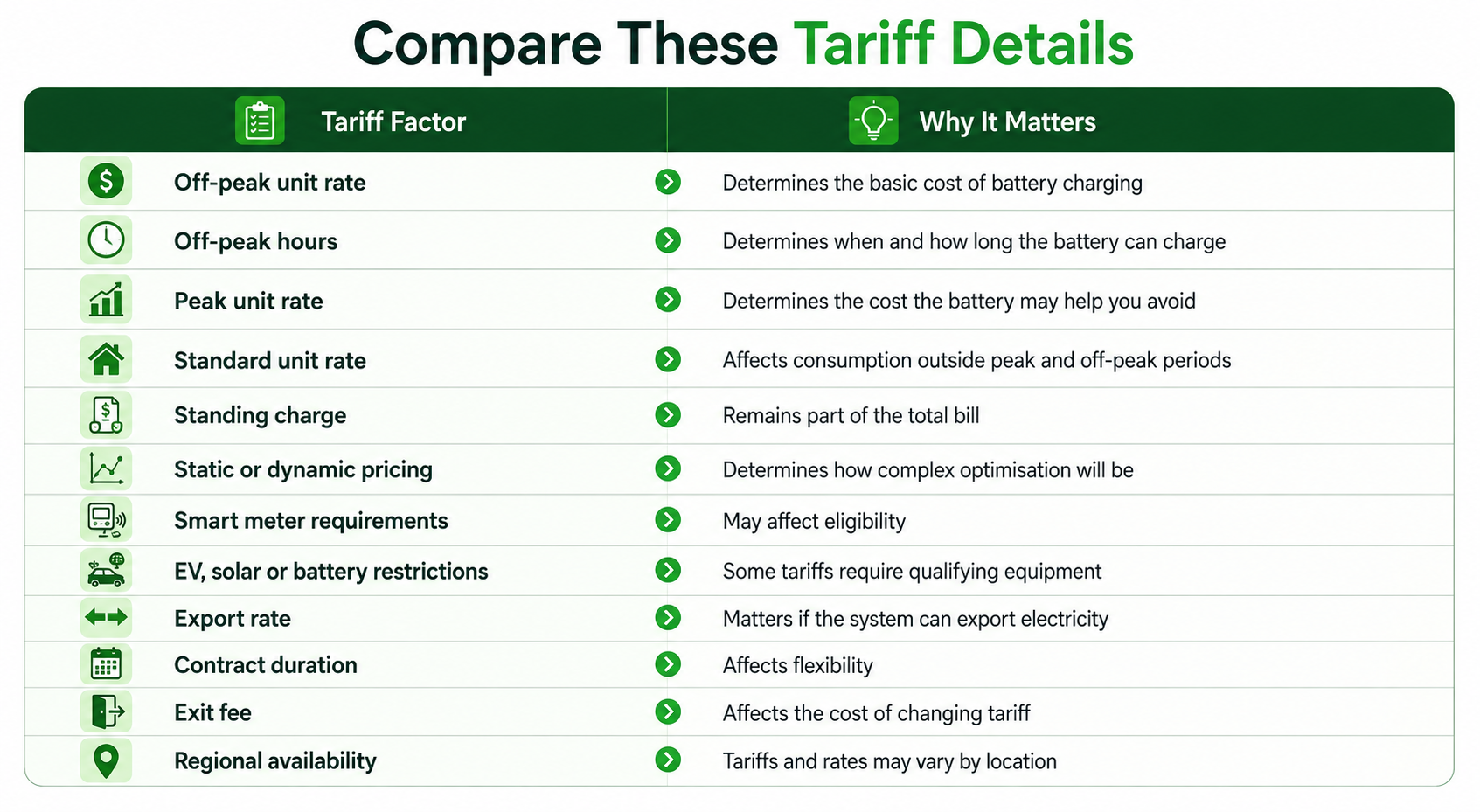
Ask these questions before switching
What are the exact off-peak hours?
Do those hours change by season or day?
Is the rate fixed, variable or dynamic?
What is the peak rate?
What happens if my battery becomes empty during peak hours?
Is a specific smart meter required?
Is the tariff available for battery-only homes?
Does the tariff require an EV or solar installation?
Can grid-charged electricity be exported?
Are there restrictions on automated control?
What are the standing charge and exit fee?
Can the battery platform access the tariff data automatically?
Citizens Advice has warned that time-of-use tariffs can be more difficult to compare than conventional tariffs because consumers must consider more variables and monitor their usage more carefully.
How to Choose the Right Battery
The right battery should be based on your energy data and intended use, not simply the largest model available.
Review your electricity consumption
Ideally, assess at least several months of half-hourly smart-meter data.
Identify:
Average daily electricity use
Peak-time consumption
Overnight consumption
Highest simultaneous demand
Seasonal changes
Weekend and weekday differences
Planned future loads
Size the battery around valuable demand
The battery should be large enough to cover a meaningful amount of expensive consumption without regularly storing electricity that is not needed.
Oversizing can increase the installation cost without producing equivalent additional savings.
Undersizing may cause the battery to empty before the expensive tariff period ends.
Check the usable capacity and depth of discharge
Ask for clear figures for:
Nominal capacity
Usable capacity
Minimum state of charge
Recommended operating range
Backup reserve
Expected degradation
Check inverter and discharge power
The system must be able to supply enough power for the loads you want it to cover.
A professional assessment should consider whether the battery can support simultaneous demand from appliances such as:
Ovens
Kettles
Induction hobs
Heat pumps
Electric showers
EV chargers
Tumble dryers
Review warranty terms carefully
Do not judge a battery warranty only by its number of years.
Check:
Warranty duration
Cycle limit
Energy-throughput limit
Retained-capacity guarantee
Installation requirements
Internet connectivity requirements
Approved operating conditions
Labour coverage
Inverter warranty
Transferability if the home is sold
Energy Saving Trust estimates that a typical battery may last approximately 10–12 years, although actual life depends on the product and how it is used.
Confirm backup capability
A home battery does not automatically mean the property will remain powered during a power cut.
Backup capability may require:
A compatible inverter
Additional switching equipment
A protected-load circuit
Sufficient battery reserve
A system designed specifically for backup operation
Battery 1st Energy also explains that backup availability depends on the battery, inverter and installation design rather than being standard in every system.
A Practical Electricity Bill Reduction Plan
Step 1: Collect your electricity data
Gather:
Recent electricity bills
Annual electricity consumption
Smart-meter interval data
Current unit rate
Current standing charge
Current tariff name
Peak-time usage
Details of any EV, solar panels or heat pump
Step 2: Identify your expensive consumption periods
Determine how much electricity you normally use during the tariff periods you want the battery to avoid.
This is the energy that may provide the greatest economic value when shifted.
Step 3: Compare appropriate time-of-use tariffs
Compare complete tariff costs using your actual consumption profile.
Do not base the decision on a supplier’s headline off-peak rate alone.
Step 4: Model battery losses
Include charging and discharging losses in every estimate.
A savings projection that assumes every imported kWh is returned to the home will overstate the likely result.
Step 5: Select the appropriate battery capacity and power
Match the proposed system to:
Shiftable consumption
Off-peak charging duration
Peak household demand
Future EV plans
Heat-pump plans
Solar plans
Backup priorities
Step 6: Configure smart battery charging
Set the system to:
Charge during financially beneficial periods
Preserve energy for expensive periods
Avoid unnecessary peak imports
Maintain an appropriate reserve
Respond to tariff changes
Account for predicted demand
Step 7: Monitor actual performance
After installation, compare:
Forecast savings
Actual charging cost
Peak electricity avoided
Battery losses
Grid imports
Battery cycles
Monthly bill changes
The strategy should be adjusted when usage patterns or tariffs change.
Practical Tips for Better Energy Savings
Shift flexible loads as well as battery charging
A battery is only one part of electricity bill reduction.
You may improve results by moving flexible consumption into off-peak periods, including:
EV charging
Hot-water heating
Dishwasher cycles
Dehumidification
Certain heating operations
Other safely schedulable appliances
Follow manufacturer safety guidance. Citizens Advice advises against scheduling appliances such as washing machines, tumble dryers and dishwashers to run while everyone is asleep because of fire risk.
Protect the most expensive period
Do not discharge the battery unnecessarily before the highest-priced period begins.
For example, using stored power during a moderate-rate afternoon may leave too little capacity for a more expensive evening peak.
Review the strategy after changing tariffs
Battery settings designed for one tariff may perform poorly on another.
Update:
Charging times
Target charge level
Discharge schedule
Peak protection
Export settings
Minimum reserve
Avoid charging more than you are likely to use
Charging a nearly full battery every night may waste money if the household does not use the stored electricity before the next charging period.
Smart charging should consider expected consumption rather than following the same target automatically.
Coordinate the battery with an EV or heat pump
EVs and heat pumps can substantially change household electricity demand.
The home may need a coordinated plan to prevent:
Battery and EV charging competing during a short window
Excessive simultaneous demand
The battery emptying too early
Unnecessary peak imports
Poor use of available grid capacity
Common Mistakes to AvoidChoosing a tariff based only on the off-peak rate
A very low night rate may be offset by an unusually high daytime or peak rate.
Compare the estimated whole-bill cost.
Assuming all stored electricity is usable
Battery losses, reserve settings and usable-capacity limits reduce the amount available to the home.
Buying the largest possible battery
A larger battery is not automatically more profitable.
The additional capacity must regularly replace expensive electricity to create value.
Ignoring discharge power
A high-capacity battery may still import grid electricity when household demand exceeds its maximum power output.
Expecting guaranteed savings
Tariffs, household behaviour, weather, equipment settings and electricity prices can change.
Savings estimates should be treated as projections rather than guarantees.
Assuming the battery provides whole-home backup
Backup must be designed into the system. It is not standard with every battery installation.
Failing to update settings
A battery schedule can become inefficient when:
The tariff changes
Clocks change
Household routines change
An EV is added
A heat pump is installed
Solar panels are added
Peak periods change
Ignoring warranties and installation quality
Battery economics depend on reliable long-term operation.
Review product warranties, installation standards, service support and monitoring arrangements before proceeding. Energy Saving Trust recommends obtaining multiple quotes from experienced, appropriately certified installers.
Do You Need Solar Panels?No. A home battery can be used for electricity bill reduction without solar panels.
A battery-only system can:
Charge from cheaper grid electricity
Supply the home during expensive periods
Reduce peak-rate grid imports
Support future EV charging
Prepare for a future heat pump
Allow solar panels to be added later
Energy Saving Trust confirms that battery storage can be used without solar and paired with a smart time-of-use tariff to buy electricity when it is cheap and avoid higher peak rates.
When solar may improve the system
Solar panels can add another energy source by generating electricity during daylight hours.
A future solar installation may allow the battery to:
Store surplus solar electricity
Increase solar self-consumption
Reduce daytime grid imports
Support export opportunities
Reduce dependence on overnight grid charging during productive months
The battery-first approach allows a homeowner to begin with tariff-based energy savings and add solar later when the timing, budget and property conditions are suitable.
How Smart Energy Management Improves SavingsA basic battery follows fixed instructions. A smart energy platform can continuously evaluate whether those instructions remain financially useful.
Battery 1st Energy starts with a battery-led strategy. Its system is designed to charge from cheaper grid electricity, reduce peak-rate consumption and create a future-ready route to solar, EV charging and heat-pump integration. The company describes its platform as using AI-first optimisation to identify improved charging, timing and savings opportunities.
Smart control can consider multiple variables
An intelligent energy management system may use:
Tariff prices
Off-peak windows
Historical household usage
Predicted demand
Current battery charge
Battery limits
Weather forecasts
Expected solar generation
EV charging requirements
Heat-pump demand
Export opportunities
Backup reserve preferences
Why automation matters
Time-of-use optimisation can become complicated when prices and household demand change regularly.
Automated control can help avoid situations such as:
Charging when the price is not sufficiently low
Discharging before the highest-priced period
Buying unnecessary electricity
Entering a peak period with insufficient battery charge
Exporting stored energy when using it at home would be more valuable
Missing a favourable dynamic tariff period
Potential future value
Eligible households may also be able to participate in energy flexibility programmes through participating suppliers or aggregators.
The National Energy System Operator’s Demand Flexibility Service can reward eligible participants for changing when they consume electricity. Participation depends on provider availability, programme rules, metering and other eligibility requirements.
Any export income or flexibility reward should be treated as a possible additional benefit—not a guaranteed part of the core electricity bill reduction calculation.
Is a Home Battery Suitable for Every Property?Not necessarily.
A battery may be more attractive when:
The household has meaningful peak-time electricity demand
A suitable time-of-use tariff is available
There is a wide tariff spread
The property has a compatible electrical system
The homeowner expects to remain in the property long enough
An EV, heat pump or solar installation is planned
Smart control can optimise the system
The proposed battery is correctly sized
A battery may be less attractive when:
Electricity consumption is already very low
Most consumption occurs during off-peak hours
Available tariffs have little price difference
The installation cost is unusually high
There is no suitable installation location
The battery cannot charge sufficiently during the cheap window
The homeowner expects a fixed, guaranteed saving
A property-specific assessment should compare the installed cost with a conservative estimate of long-term savings.
Questions to Ask a Home Battery ProviderBefore accepting a proposal, ask:
What consumption data was used for the savings estimate?
What tariff rates were assumed?
Were battery losses included?
What is the battery’s usable capacity?
What is its maximum charging and discharge power?
How much peak demand is expected to be covered?
What happens if electricity prices change?
Can the charging strategy update automatically?
What warranty limits apply?
Is backup power included?
Can solar, an EV charger or a heat pump be added later?
Are export permissions or network approvals required?
Who provides ongoing monitoring and support?
Are projected savings guaranteed or illustrative?
What assumptions would cause the savings to be lower?
A trustworthy proposal should explain both the potential benefits and the circumstances in which actual savings may differ.
Conclusion
A home battery can support meaningful electricity bill reduction by changing when your home purchases electricity.
The strategy is straightforward: charge the battery using cheap electricity tariffs, store that energy and use it when grid electricity is more expensive. The strongest results usually come from combining the right time-of-use tariff, correctly sized equipment, accurate consumption data and intelligent battery charging.
A battery can begin working without solar panels and provide a foundation for future solar generation, EV charging, heat-pump integration and wider smart energy services. However, the system must be designed around the individual property. Savings depend on the tariff spread, consumption pattern, battery efficiency, installation cost and quality of ongoing optimisation.
Battery 1st Energy helps UK homeowners assess whether a battery-first energy system makes commercial sense for their home. The process considers existing electricity use, tariff opportunities and future energy plans rather than relying on a one-size-fits-all package.
Explore your home’s potential electricity savings and check whether a battery system may be suitable: Complete the Battery 1st Energy qualification assessment.
