
Blog
Stay Ahead with Smarter Home Energy Insights
Welcome to the Battery 1st blog, where we share practical insights, smart energy ideas, and clear guidance on battery storage, solar, EV charging, tariffs, and the future of home energy. Whether you're exploring your first battery system, planning future upgrades, or looking for smarter ways to cut electricity costs, our blog is here to help you make better-informed decisions. Dive into our latest posts and stay ahead in a fast-changing energy world.

Savings.
Flexibility.
Optimisation.
Expansion.
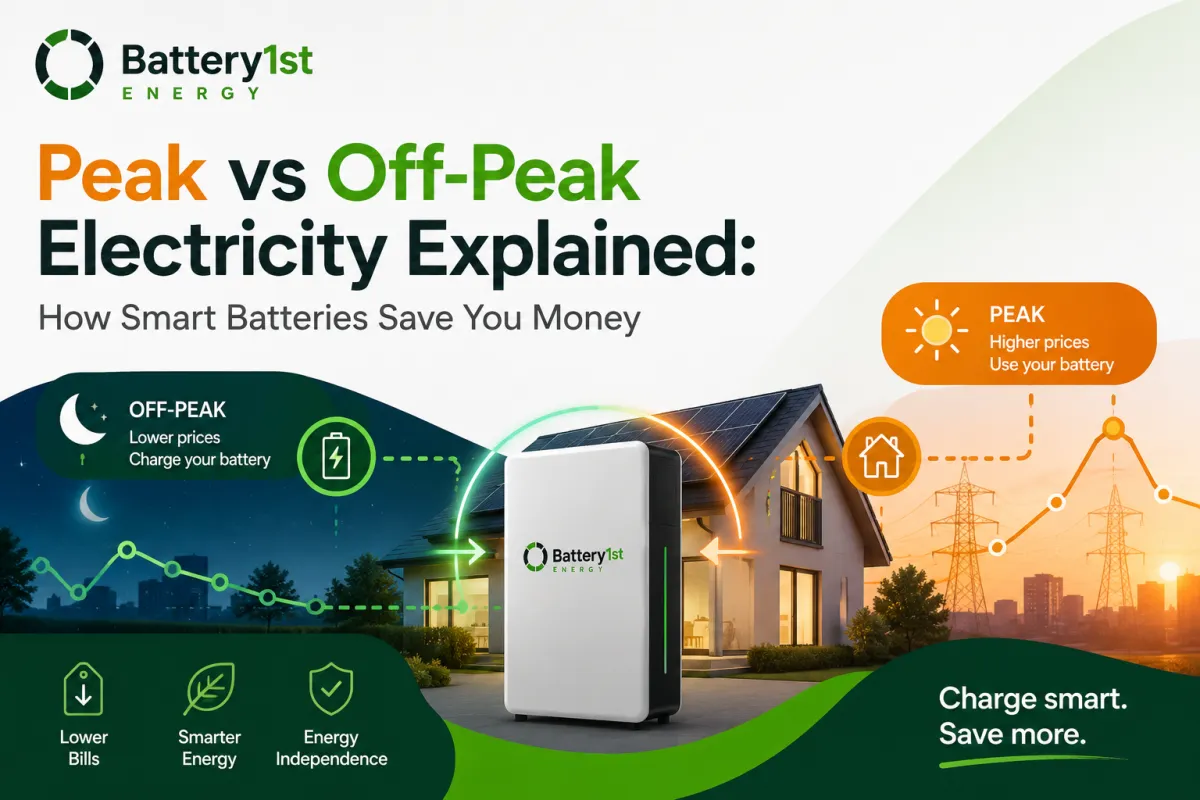
Peak vs Off-Peak Electricity Explained: How Smart Batteries Save You Money
The electricity that powers your home does not always have the same value throughout the day. Under the right tariff, electricity can cost considerably less overnight and more during busy periods when national demand rises.
Understanding peak vs off-peak electricity can therefore help you reduce your energy bills without simply using less electricity. The objective is to change when you buy power from the grid.
A smart home battery makes this easier. It charges during cheaper periods, stores the electricity and powers your home later when grid prices are higher.
The basic strategy is:
Buy electricity during cheap electricity hours, store it and use it during expensive hours.
However, actual battery savings depend on your tariff, household usage, battery capacity, charging efficiency and system controls. This electricity tariff guide explains how peak and off-peak pricing works in the UK, how battery storage can take advantage of it and what to check before switching tariffs.
Quick Answer: How Do Peak and Off-Peak Electricity Rates Work?
Peak electricity is electricity used during periods of higher national demand. A time-of-use tariff may charge a higher unit rate during these hours.
Off-peak electricity is electricity used during lower-demand periods. These periods often occur overnight, although the exact hours depend on the supplier and tariff.
A smart battery can charge at the lower off-peak rate and discharge when the peak rate applies. The household then buys less expensive electricity directly from the grid.
Energy Saving Trust explains that time-of-use tariffs charge different prices depending on when electricity is consumed. Peak periods generally have higher prices, while lower-demand off-peak periods usually have lower rates.
What Is Peak vs Off-Peak Electricity?
Peak vs off-peak electricity describes a pricing structure in which the unit cost of electricity changes according to the time it is used.
Unlike a single-rate tariff, which applies one unit rate throughout the day, a multi-rate or time-of-use tariff may divide the day into:
Peak hours
Off-peak hours
Shoulder or intermediate hours
Peak vs off-peak electricity: what is peak electricity?
Peak electricity is power consumed during periods when many homes and businesses are using the electricity network at the same time.
Peak demand often increases when people:
Return home from work
Cook evening meals
Use electric heating
Boil kettles
Run washing machines or dishwashers
Watch television
Charge devices
Use other household appliances
On a time-of-use tariff, electricity used during these periods may be charged at the highest rate.
Peak vs off-peak electricity: what is off-peak electricity?
Off-peak electricity is power consumed when demand across the network is lower.
These periods commonly occur:
Late at night
During the early morning
At selected daytime periods
At weekends on certain tariffs
When renewable generation is abundant
During unusually low-demand periods
Suppliers may offer lower off-peak rates to encourage customers to move flexible consumption away from busy periods.
What are shoulder hours?
Shoulder hours sit between peak and off-peak periods.
They may have a unit rate that is:
Higher than the off-peak rate
Lower than the peak rate
Similar to a normal single-rate tariff
Not every tariff includes shoulder periods. Some use only two rates, while others divide the day into several price bands.
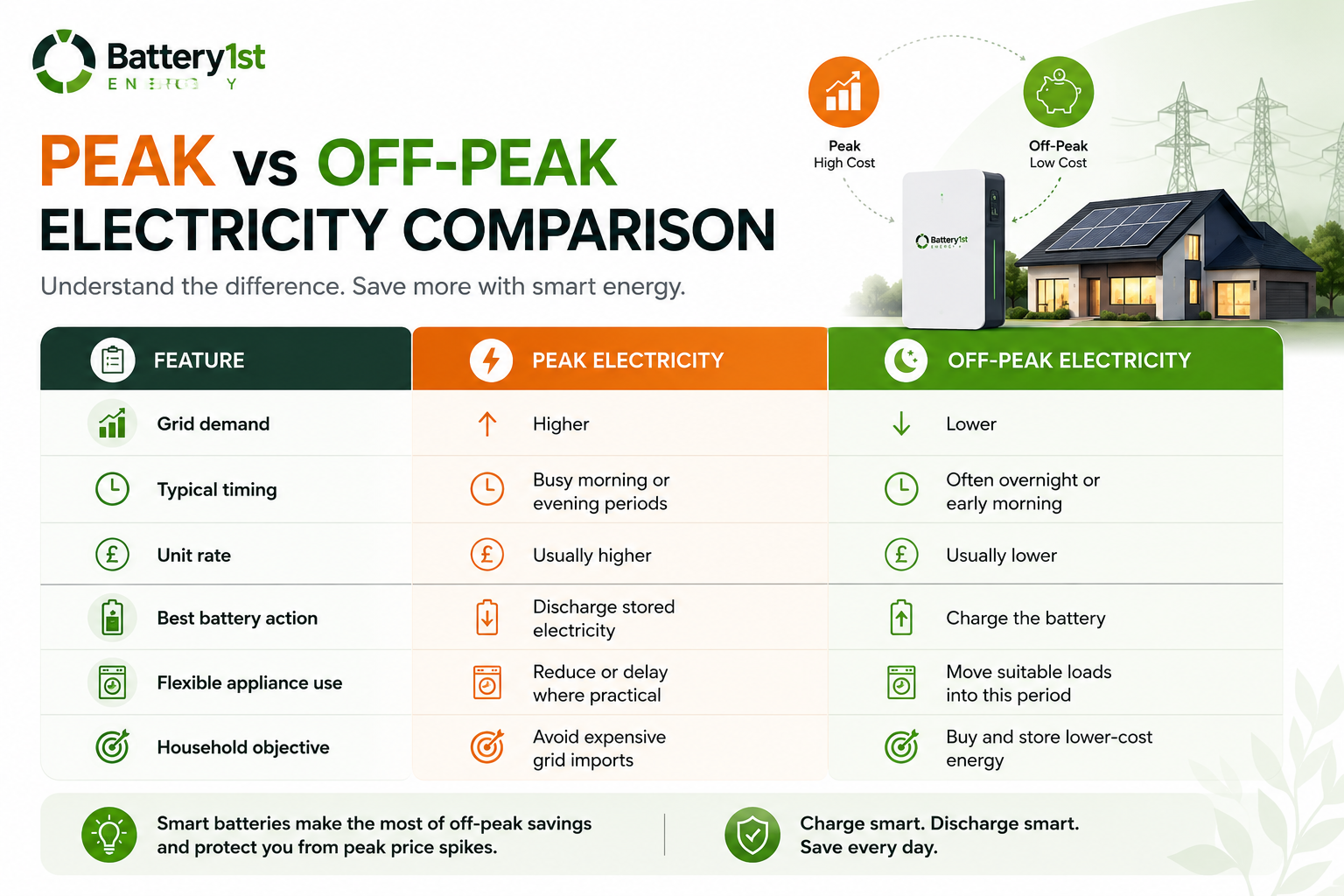
The exact hours and prices are determined by the individual tariff rather than one universal UK timetable.
Why Does Electricity Cost More at Certain Times?
Electricity must be generated and delivered at approximately the same time it is needed.
Demand changes throughout the day. When millions of households use appliances simultaneously, the electricity system may need additional generation to meet that demand.
Energy Saving Trust identifies mornings and evenings as common high-demand periods. It also explains that time-of-use tariffs use higher peak prices and lower off-peak prices to encourage customers to move demand.
Demand influences electricity prices
When demand rises, the system may need to use more expensive sources of electricity generation.
Wholesale electricity prices can also be affected by:
Fuel costs
Weather
Renewable generation
Power station availability
Interconnector flows
Network constraints
Seasonal demand
International energy markets
Your retail tariff will not necessarily reflect wholesale prices immediately. However, dynamic tariffs may respond to market conditions more frequently than fixed or static tariffs.
Renewable generation can create cheaper periods
Electricity supply from wind and solar changes with the weather.
At times when renewable generation is strong and national demand is relatively low, wholesale electricity may become cheaper. Some dynamic tariffs pass more of this variation to customers.
This can create opportunities to:
Charge a home battery
Charge an electric vehicle
Heat water
Run suitable appliances
Reduce demand during a later peak period
Time shifting helps the wider electricity system
Moving flexible electricity consumption away from the busiest periods can reduce pressure on the grid.
One household shifting a few kilowatt-hours may appear insignificant. Thousands of batteries, EV chargers and smart appliances responding together can create valuable flexibility.
What Are Peak Electricity Hours in the UK?
There is no single set of peak electricity hours that applies to every UK household.
Peak periods depend on:
Your energy supplier
The tariff you have selected
The meter configuration
The region
The day of the week
The season
Whether the tariff is static or dynamic
When does electricity demand usually peak?
High household demand frequently occurs during weekday evenings when people return home and begin cooking, heating and using appliances.
However, this does not mean every time-of-use tariff uses the same evening peak period.
One tariff might charge more from 4pm to 7pm. Another might use a longer peak period. A dynamic tariff may change its expensive hours each day.
Check the tariff, not a general timetable
Do not programme a battery or appliance based on a generic internet list of peak hours.
Check:
Your tariff information
Your supplier’s app or website
Your contract terms
The display on your smart-energy platform
Written confirmation from the supplier
Using the wrong schedule could cause a battery to charge when electricity is expensive or discharge before the highest-price period begins.
What Are Off-Peak Electricity Hours?
Off-peak hours are the periods when a time-of-use tariff applies a lower unit rate.
They often occur overnight because demand is generally lower while most people are asleep. However, off-peak windows can also appear during the afternoon, at weekends or at changing times under a dynamic tariff.
Citizens Advice warns that off-peak times differ between suppliers and advises customers to check their specific tariff carefully.
Are off-peak hours always at night?
No.
Possible off-peak structures include:
One continuous overnight window
Several separate low-cost periods
Weekend discounts
EV charging windows
Daily dynamic price periods
Seasonal schedules
Economy 10, for example, may divide cheaper electricity across several daytime and overnight blocks rather than providing one continuous period.
Can off-peak hours change when the clocks change?
They can.
Some older meter arrangements and tariffs may follow fixed clock settings that shift relative to British Summer Time. Other modern smart tariffs may handle seasonal changes differently.
Confirm whether the stated hours:
Remain the same throughout the year
Move when the clocks change
Vary between weekdays and weekends
Change daily
Are shown in local time or another time standard
How do I find my cheap electricity hours?
You can normally find your cheap electricity hours by checking:
Your electricity bill
The tariff information label
Your online supplier account
Your supplier’s mobile app
Your smart-meter documentation
Your home battery control platform
Contact the supplier directly when the information is unclear.
Which UK Tariffs Offer Off-Peak Rates?
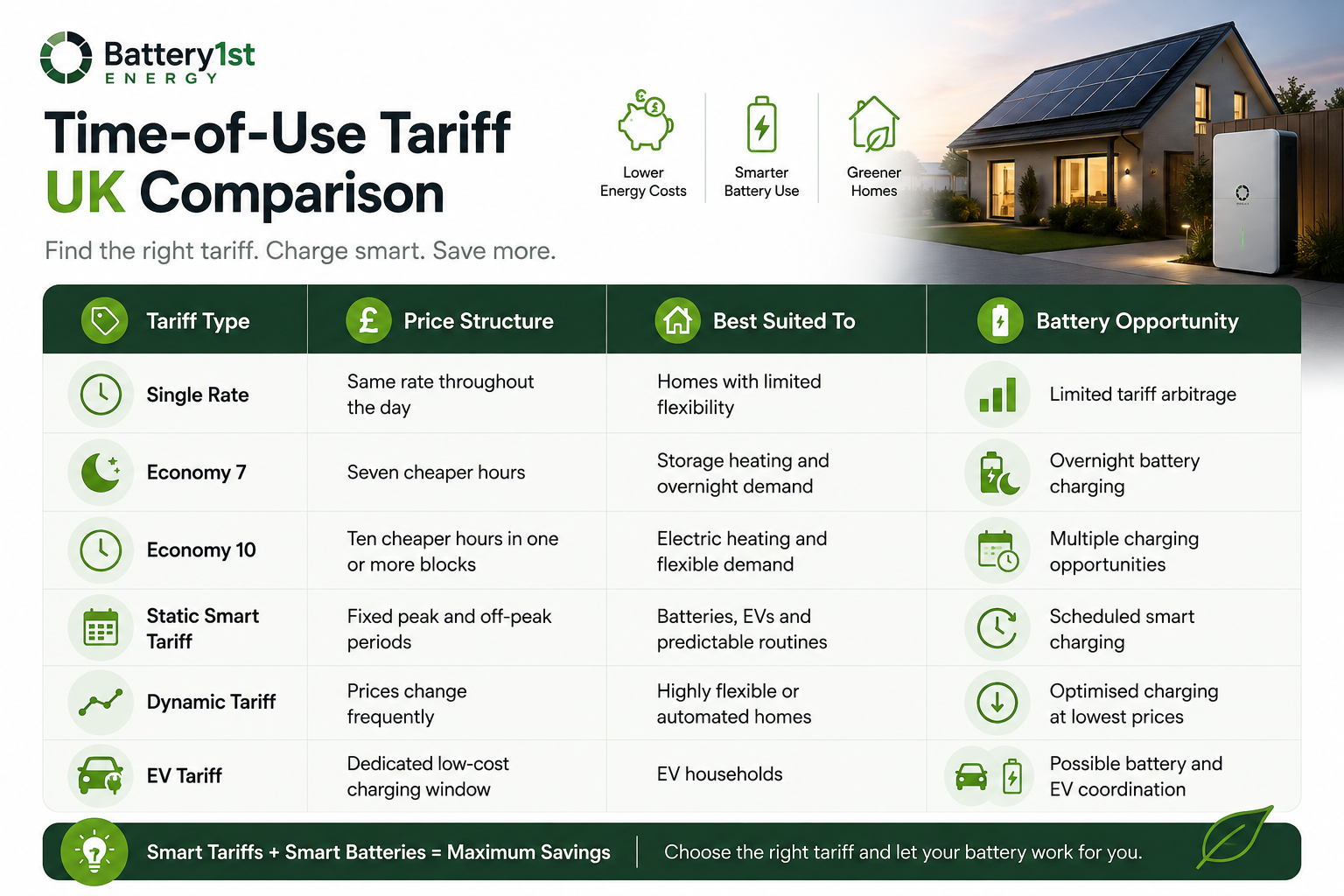
Several tariff structures can provide cheaper electricity at selected times.
This section is a general electricity tariff guide. Availability, rates and eligibility can change, so compare current offers before switching.
Single-rate tariffs
A single-rate tariff charges the same unit rate throughout the day.
It may be suitable when:
You cannot shift much electricity use
Your consumption is distributed evenly
You prefer simple billing
Available peak rates are too expensive
You do not have a battery, EV or flexible electric heating
A single-rate tariff does not offer a dedicated cheap period for grid battery charging.
Economy 7
Economy 7 generally provides seven hours of lower-priced electricity in each 24-hour period.
The cheaper hours commonly occur overnight, but exact times differ by supplier, meter and region. Citizens Advice states that Economy 7 usually provides seven off-peak hours, often in one continuous overnight block.
Economy 7 was traditionally associated with:
Storage heaters
Immersion heaters
Overnight water heating
Other equipment designed to use night-rate electricity
It may also support battery charging, provided the battery and meter arrangement are compatible.
Economy 10
Economy 10 generally provides ten hours of lower-priced electricity.
Unlike Economy 7, the hours may be divided into several periods across the day and night.
This can help households with electric heating, but the tariff must be assessed carefully because the higher-rate periods may be more expensive than a conventional tariff.
Static smart time-of-use tariffs
A static smart time-of-use tariff has predetermined rate periods.
For example, it may offer:
A cheap overnight rate
A standard daytime rate
An expensive evening rate
The times and prices are published in advance and normally follow a regular schedule.
Static tariffs make battery control relatively straightforward because the system can follow a consistent charging plan.
Dynamic smart tariffs
Dynamic tariffs change prices more frequently.
Prices may vary:
Every day
Every half-hour
According to wholesale electricity costs
According to expected grid demand
According to renewable generation
Energy Saving Trust explains that dynamic tariffs can use different unit prices at different times, with rates set closer to real-time consumption.
These tariffs may create strong savings opportunities, but manual optimisation can be difficult. Intelligent battery software can assess the changing price schedule and decide when charging is worthwhile.
EV tariffs
EV tariffs commonly provide a cheap overnight window for vehicle charging.
Some may require:
An electric vehicle
A compatible EV charger
A smart meter
Specific charger integration
Supplier-controlled charging
A home battery may also be able to charge during the cheap window, but this depends on the tariff’s terms and technical restrictions.
How Does a Smart Home Battery Save Money?
A smart home battery changes when your household imports electricity from the grid.
Instead of purchasing electricity only when an appliance needs it, you can purchase energy earlier, store it and use it later.
Energy Saving Trust confirms that home battery storage can charge when a tariff is cheap and provide stored electricity when energy prices are high.
Step 1: The battery identifies cheap electricity hours
The battery or energy management platform receives a charging schedule.
On a static tariff, the cheap hours may be programmed in advance.
On a dynamic tariff, the system may obtain future prices and identify the lowest-cost periods automatically.
Step 2: The battery charges at the off-peak rate
Electricity is imported from the grid and stored in the battery.
The system may select a target charge based on:
Expected household consumption
Current battery level
Tariff prices
Charging-window length
Weather forecasts
Expected solar generation
Backup reserve
EV or heat-pump demand
Step 3: The battery supplies the home during peak hours
When the higher unit rate begins, the battery provides stored electricity to the home.
This can support loads such as:
Lighting
Refrigeration
Cooking
Home-office equipment
Entertainment systems
Laundry appliances
Heat pumps
General sockets
The home imports less peak-rate electricity while the battery has sufficient stored energy and output power.
Step 4: The system repeats and adjusts
A basic battery follows the same schedule every day.
A smart energy system can modify the schedule as conditions change.
It might:
Charge less when expected demand is low
Charge more before a high-consumption day
Preserve energy for the most expensive hours
Use solar before grid electricity
Avoid charging when the price difference is too small
Coordinate with an EV charger
retain a backup reserve
Example Smart Battery Savings Calculation
The following example shows how peak vs off-peak electricity prices can create potential battery savings.
The rates are illustrative and do not represent a current supplier tariff or guaranteed saving.
Example household assumptions
Assume:
Electricity supplied by the battery: 8kWh per day
Illustrative off-peak rate: 9p per kWh
Illustrative peak rate: 30p per kWh
Assumed round-trip efficiency: 90%
Standing charge: excluded
Battery and installation costs: excluded
Step 1: Calculate the electricity required for charging
The battery must import more energy than it delivers because some electricity is lost through charging, storage, conversion and discharge.
8kWh ÷ 0.90 = 8.89kWh
The battery must therefore buy approximately 8.89kWh during the off-peak period to provide 8kWh later.
Step 2: Calculate the charging cost
8.89kWh × £0.09 = approximately £0.80
Step 3: Calculate the peak electricity avoided
8kWh × £0.30 = £2.40
Step 4: Calculate the illustrative daily tariff saving
£2.40 − £0.80 = £1.60
Step 5: Estimate the illustrative annual saving
£1.60 × 365 = £584
In this simplified example, shifting 8kWh every day could produce approximately £584 in annual unit-rate savings.
Actual savings may be lower or higher because of:
Tariff changes
Seasonal demand
Battery efficiency
Battery degradation
Variable charging levels
Inverter consumption
Installation cost
Finance cost
Maintenance
Solar generation
Export payments
Days when the battery is not fully used
The calculation also does not remove the electricity standing charge. Citizens Advice describes the standing charge as a separate daily cost for remaining connected to the energy network.
Smart Battery Savings Formula
A more accurate battery savings formula is:
Peak electricity avoided − off-peak charging cost = gross tariff saving
Or:
Energy delivered by battery × avoided peak rate − energy imported for charging × off-peak rate
To estimate annual savings:
Average daily gross tariff saving × expected operating days
What Affects Battery Savings?
1. The difference between peak and off-peak rates
The tariff spread is the difference between:
The price paid to charge the battery
The price of the electricity the battery replaces
A wider spread generally provides a stronger opportunity.
For example:
Off-peak rate: 10p
Peak rate: 30p
Gross spread: 20p per kWh
However, battery losses reduce the effective spread.
2. How much electricity you can shift
A large price difference creates little value when the household shifts only a small amount of electricity.
Potential battery savings increase when the system regularly replaces meaningful peak-time consumption.
Relevant demand may include:
Evening cooking
Electric heating
Heat-pump operation
Hot-water heating
Home working
Electric vehicle support
General household use
3. Battery usable capacity
A battery’s advertised capacity may not equal the amount available to the home.
For example, a nominal 10kWh battery may reserve part of its capacity to protect battery health.
Compare:
Nominal capacity
Usable capacity
Minimum state of charge
Backup reserve
Warranty operating limits
Energy Saving Trust notes that a battery may stop discharging at a protected minimum level rather than allowing the charge to fall to zero.
4. Battery efficiency
Some energy is lost during charging and discharging.
A tariff comparison should use the effective cost of delivered battery energy, not simply the advertised off-peak rate.
Use this formula:
Effective stored-energy cost = off-peak rate ÷ battery efficiency
For example:
9p ÷ 90% = 10p per delivered kWh
This means electricity bought at 9p per kWh effectively costs approximately 10p per kWh after a 10% round-trip loss.
5. Battery output power
Battery capacity is measured in kWh. Battery power is measured in kW.
A battery may contain enough energy for the evening but still import peak electricity if household demand exceeds its inverter output.
For example, a battery inverter rated at 5kW cannot independently supply a 7kW household load. The grid may provide the remaining 2kW.
6. The length of the charging window
The battery must recharge before the cheap period ends.
Use:
Required charging power = charging energy ÷ available hours
A battery requiring 10kWh during a four-hour window needs an average charging rate of at least 2.5kW, before accounting for losses and other limitations.
7. Household behaviour
The battery delivers more value when its stored electricity is preserved for high-price periods.
Savings can fall when the system:
Discharges during a cheaper shoulder period
Charges outside the off-peak window
Fills more than the household needs
Empties before the main peak period
Competes with an EV for limited charging capacity
8. Seasonal consumption
Winter demand may be higher because of:
Longer lighting hours
More time spent indoors
Electric heating
Heat-pump operation
Reduced solar generation
Hot-water demand
A smart battery schedule should adapt to seasonal changes.
9. Tariff changes
An energy supplier may change:
Unit rates
Off-peak hours
Peak periods
Contract terms
Export rates
Eligibility requirements
Battery settings should be reviewed whenever the tariff changes.
10. System intelligence
Automation can materially affect how well a battery uses a time-of-use tariff.
A fixed schedule may work adequately on a simple tariff. More complex pricing benefits from software that can interpret future prices and expected household demand.
Who Is Most Likely to Benefit?
Peak vs off-peak electricity pricing may work particularly well for households that:
Use significant electricity during the evening
Have a smart home battery
Own an electric vehicle
Run a heat pump
Use electric water heating
Have flexible household demand
Can access a large tariff spread
Have a suitable smart meter
Can automate charging
Plan to add solar panels later
Households with high evening use
Homes with substantial evening demand may have more expensive electricity for a battery to replace.
The battery can cover part of the period when cooking, heating and other appliances are operating simultaneously.
EV households
An EV can usually charge directly during the off-peak window.
The home battery can then supply household demand after the cheap period ends.
The system should coordinate charging so that:
The EV receives enough energy
The home battery reaches its target
The property does not exceed its supply limit
Charging finishes before the higher rate begins
Homes with heat pumps
A battery can reduce the amount of high-rate electricity used by a heat pump during expensive periods.
The correct design depends on:
Heat loss
Weather
Heating schedule
Heat-pump electrical consumption
Battery size
Tariff windows
Thermal storage
Homes planning future solar panels
A battery-first system can use off-peak grid electricity now.
Solar panels can later provide another charging source, allowing the battery to store surplus daytime generation.
Who May Not Benefit From a Time-of-Use Tariff?
A time-of-use tariff is not automatically cheaper.
It may be unsuitable when:
Most electricity use occurs during peak hours
The household cannot shift demand
Peak rates are particularly high
The off-peak window is too short
Electricity consumption is very low
The tariff’s standing charge is higher
The battery is too small
The battery cannot charge quickly enough
Automated control is unavailable
The household prefers predictable pricing
Energy Saving Trust advises that a smart time-of-use tariff is unlikely to work well when a household cannot move consumption away from peak periods.
Compare the estimated total annual cost rather than choosing a tariff solely because it advertises a very low night rate.
Do You Need Solar Panels?
No. A home battery can save money through peak vs off-peak electricity pricing without solar panels.
The battery can:
Charge from the grid during off-peak hours
Store the cheaper electricity
Supply the home during higher-rate periods
Recharge during the next cheap window
Energy Saving Trust confirms that batteries can operate without solar panels and can be combined with a smart time-of-use tariff to avoid peak rates.
What changes when solar is added?
Solar panels can provide low-cost daytime electricity.
A combined system can prioritise energy in this order:
Use live solar generation in the home
Store surplus solar electricity
Export remaining surplus where appropriate
Use stored electricity when solar output falls
Charge from off-peak grid electricity when beneficial
The correct order may change depending on your import tariff, export tariff, weather forecast and expected household demand.
How Battery 1st Energy Uses Peak and Off-Peak Pricing
Battery 1st Energy helps homeowners begin with a smart home battery rather than requiring solar panels as the first step.
The battery stores cheaper off-peak electricity and powers the home when electricity prices rise.
Its AI-led energy management is designed to continuously optimise:
When the battery charges
How much electricity it stores
When stored energy is used
How much reserve is maintained
How tariff changes affect charging
How future solar generation is used
How EV or heat-pump demand is coordinated
This battery-first approach can help homeowners save money now while creating a flexible system that can later include:
Solar panels
EV charging
A heat pump
Additional battery capacity
Wider smart-home energy controls
The objective is not simply to install a battery. It is to operate the battery around the home’s actual consumption and available electricity prices.
How to Choose a Time-of-Use Tariff
Before choosing a time-of-use tariff UK households should compare the complete pricing structure.
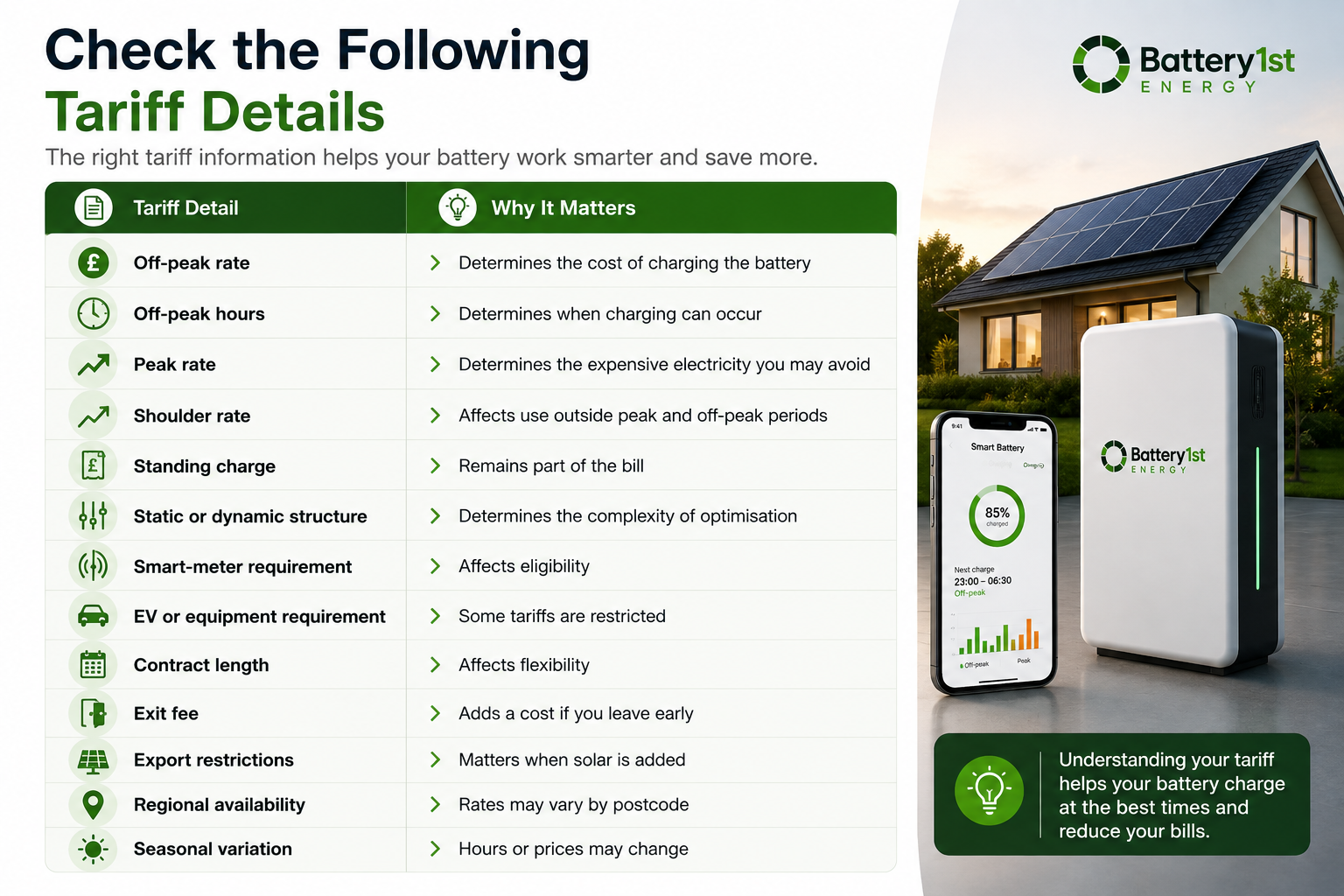
Questions to ask the supplier
What are the exact cheap electricity hours?
Do the hours change when the clocks change?
Are prices fixed or variable?
Is there a separate evening peak?
How far in advance are dynamic prices published?
Is a particular smart meter required?
Can a grid-connected home battery use the tariff?
Is an EV or EV charger required?
What is the standing charge?
Are there exit fees?
Can the tariff work with solar later?
Are grid-charged battery exports permitted?
What happens if the smart meter loses communication?
Can the battery platform receive tariff data automatically?
How to Compare a Time-of-Use Tariff With a Standard Tariff
Use your own half-hourly consumption data where possible.
Step 1: Record your existing annual cost
Include:
Electricity units
Unit rate
Standing charge
VAT where applicable
Any discounts
Step 2: Divide consumption by tariff period
Estimate how much electricity would be used during:
Off-peak hours
Shoulder hours
Peak hours
Step 3: Add battery charging losses
Do not assume that every kWh bought enters and leaves the battery without loss.
Step 4: Model battery discharge
Estimate how much peak consumption the battery could realistically replace.
Account for:
Usable capacity
Inverter output
Minimum reserve
Seasonal demand
Charging-window length
Step 5: Compare whole-year costs
Compare:
Standard tariff annual cost
against:
Time-of-use import cost + standing charge + battery losses
Do not compare only the two advertised unit rates.
Practical Ways to Use More Off-Peak Electricity
A battery can automate much of the energy shifting, but other flexible loads may also be moved.
Charge the home battery automatically
Programme the battery to charge only when:
The rate is sufficiently low
The home is likely to need the stored energy
The battery has enough time to charge
The next peak period justifies charging
Solar generation is not expected to provide the required energy
Charge an EV during the cheapest window
Schedule the EV to begin after the off-peak period starts and stop before it ends.
Coordinate the EV and home battery so both systems can charge without exceeding the property’s electrical capacity.
Heat water at lower-cost times
A compatible immersion heater, hot-water cylinder or smart control may allow water heating during off-peak hours.
Calculate whether the lower electricity price compensates for heat loss before the hot water is used.
Pre-heat strategically
Some heat-pump households may be able to warm the home slightly before an expensive peak period.
This should be done carefully to preserve comfort and avoid using more total energy than necessary.
Schedule suitable appliances
Some appliances can be used during cheaper periods, provided it is practical and safe.
Avoid running high-risk appliances unattended solely to obtain a lower electricity rate. Follow manufacturer instructions and recognised fire-safety guidance.
Common Peak vs Off-Peak Electricity Mistakes
Choosing the tariff with the lowest headline rate
The cheapest advertised off-peak rate does not automatically produce the lowest bill.
A tariff may combine:
A very low overnight rate
A high daytime rate
A very high evening peak
A higher standing charge
Compare the complete cost.
Assuming the same off-peak hours apply everywhere
Cheap electricity hours differ by supplier, tariff, region and meter.
Always verify the exact schedule.
Ignoring battery efficiency
Battery losses increase the effective cost of stored electricity.
Use the effective delivered cost when estimating savings.
Charging the battery completely every night
A full charge may not be economical when:
Household demand will be low
Solar generation is expected
The tariff spread is small
The battery already contains enough energy
Smart charging should target expected demand rather than automatically filling the battery.
Discharging too early
Using stored energy during a moderate-rate period may leave the battery empty during the most expensive hours.
The control strategy should prioritise the highest-value period.
Buying a battery with insufficient output
A large kWh capacity does not guarantee that the battery can support all appliances simultaneously.
Check its continuous and peak power ratings.
Forgetting the standing charge
Battery storage can reduce unit-rate costs, but it does not normally remove the daily standing charge while the home remains connected to the grid.
Expecting guaranteed savings
Battery savings depend on variables that can change.
A trustworthy estimate should explain:
Tariff assumptions
Usage assumptions
Efficiency assumptions
Battery limitations
Seasonal differences
Installation costs
Circumstances that could reduce savings
Peak vs Off-Peak Electricity Checklist
Before switching tariffs or installing a battery, confirm:
I know my current annual electricity use.
I have reviewed half-hourly smart-meter data.
I know how much electricity I use during peak periods.
I have confirmed the exact off-peak hours.
I have compared the peak, shoulder and off-peak rates.
I have included the standing charge.
I know whether the tariff is static or dynamic.
I have checked the battery’s usable capacity.
I have checked the battery’s charging power.
I have checked the battery’s discharge power.
I have included charging and discharging losses.
I know whether backup power is included.
I have considered future solar, EV and heat-pump plans.
I understand that savings are estimates rather than guarantees.
I have compared the total projected annual cost.
Conclusion
Understanding peak vs off-peak electricity allows you to make a more informed decision about when your home buys power from the grid.
Peak electricity generally costs more under a time-of-use tariff because it is consumed during high-demand periods. Off-peak electricity usually costs less because demand is lower.
A smart home battery can use this price difference by:
Charging during cheap electricity hours
Storing lower-cost energy
Powering the home when prices rise
Reducing peak-rate grid imports
Automatically adapting to tariffs and household demand
The best results depend on more than finding the lowest off-peak rate. Your tariff, smart-meter data, battery size, charging window, inverter power and future energy plans must work together.
Battery 1st Energy helps homeowners begin with a smart battery system designed around lower-cost off-peak charging. Its AI-led controls continuously optimise when electricity is stored and used, while leaving a clear path to add solar panels, EV charging or a heat pump later.
Discover whether a smart home battery could work with your household usage and available tariffs by completing the Battery 1st Energy home qualification assessment.

A better way to think about home energy
Most homeowners have been taught to think about energy in only one direction: buy from the grid and use it.
Battery First changes that.
Your home can become more active. It can buy power more intelligently. It can keep free generation for later. And in the right setup, it can sell energy back when the grid needs support.
That is a fundamentally better energy position than simply being a passive bill payer.
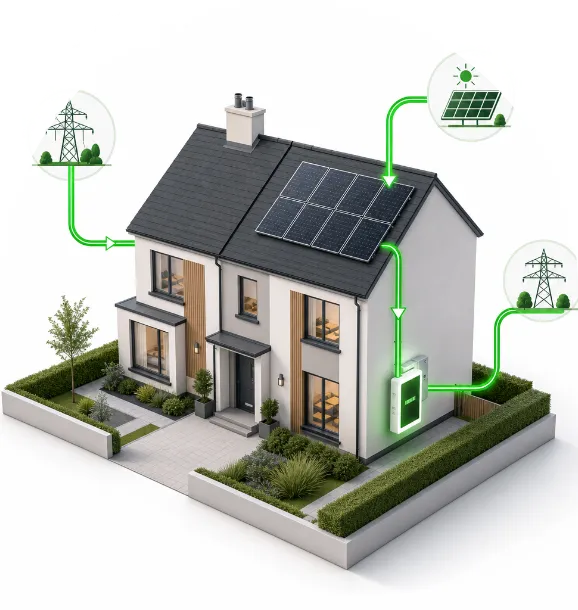

Buy electricity smarter. Store it. Use it. And when the time is right, sell it back.


Quick links
Other
© Battery 1st Energy. 2026. All Rights Reserved.