
Blog
Stay Ahead with Smarter Home Energy Insights
Welcome to the Battery 1st blog, where we share practical insights, smart energy ideas, and clear guidance on battery storage, solar, EV charging, tariffs, and the future of home energy. Whether you're exploring your first battery system, planning future upgrades, or looking for smarter ways to cut electricity costs, our blog is here to help you make better-informed decisions. Dive into our latest posts and stay ahead in a fast-changing energy world.

Savings.
Flexibility.
Optimisation.
Expansion.
What Size Home Battery Do I Need UK? A Complete Guide
If you are asking, “What size home battery do I need UK?”, the most accurate answer is not based on the number of bedrooms in your home. It depends on how much electricity you use, when you use it, how much expensive electricity you want to replace and whether the battery will also support solar panels, an electric vehicle, a heat pump or backup power.
For many households, a battery somewhere between 5kWh and 15kWh may be an appropriate starting point for assessment. However, choosing a home battery size from a general average can lead to an expensive mistake.
A battery that is too small may run out before the most expensive electricity period ends. A battery that is too large may cost more without producing enough additional savings to justify the extra capacity.
The right approach is to size the system around measurable household demand.
The best home battery is not necessarily the biggest battery. It is the battery that can store enough useful energy, deliver enough power and recharge within your cheapest tariff window.
This battery sizing guide explains how to calculate the right battery storage capacity for a UK home and what to review before requesting an installation quote.
What Size Home Battery Do I Need in the UK?
A typical UK home battery system might have around 10kWh of storage capacity, but this should be treated as a market reference rather than a recommendation for every property. Energy Saving Trust states that there is no single exact sizing formula and recommends getting property-specific advice based on individual needs and circumstances.
As an initial guide:
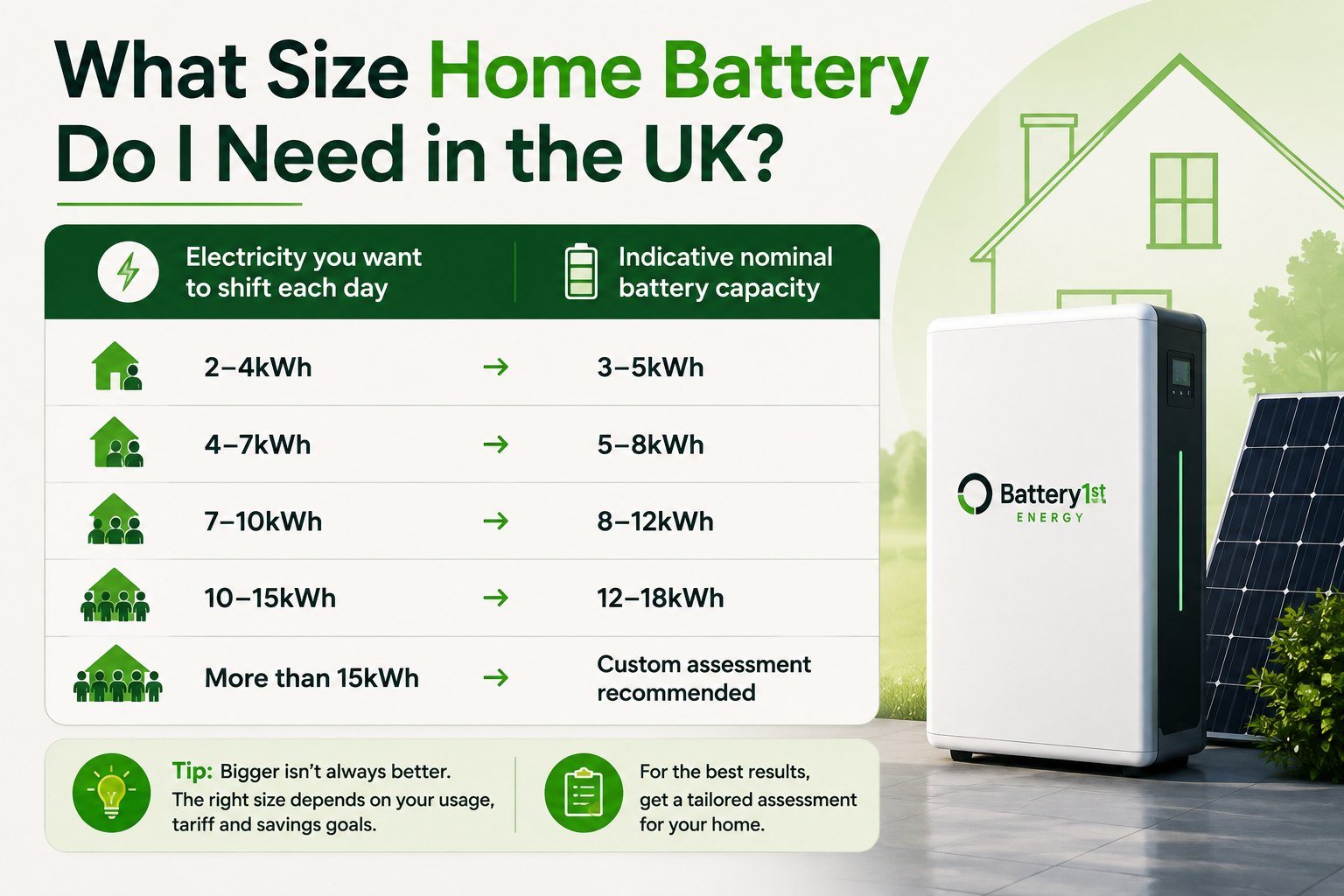
These are indicative assessment ranges, not product recommendations. The final size must account for usable capacity, efficiency, reserve settings, tariff structure, charging speed and future energy needs.
What size home battery do I need in the UK for bill savings?
For electricity bill reduction, size the battery around the amount of electricity you normally buy during expensive tariff periods.
For example, suppose your smart-meter data shows that you use an average of 6kWh between the end of your cheap overnight tariff and the beginning of the next cheap period. A battery with approximately 6–8kWh of usable capacity may be an appropriate starting point.
You do not necessarily need a battery large enough to cover your entire daily electricity use. You need enough storage to cover the consumption that is financially valuable to shift.
What size home battery do I need in the UK without solar?
A battery-only household should usually size its system around:
Electricity used during peak or standard-rate periods
The duration of the cheap charging window
The difference between off-peak and peak rates
The battery’s charging power
Expected winter demand
Future EV or heat-pump plans
Home batteries can charge directly from the grid during cheaper periods and discharge when prices are higher. Solar panels are not required for this type of tariff-based saving.
What size home battery do I need in the UK with solar?
A solar-connected battery should normally be sized around:
The amount of surplus solar generation available for storage
Electricity consumption after solar generation falls
Overnight household demand
Seasonal differences in solar output
The value of exporting electricity compared with storing it
Any off-peak grid-charging strategy
Installing a very large battery does not automatically increase solar savings. The battery must receive enough surplus generation or cheap grid electricity to charge regularly.
The Difference Between kW and kWh
One of the most common battery sizing mistakes is focusing only on storage capacity.
A battery system has two important ratings:
Kilowatt-hours, or kWh: How much energy the battery can store
Kilowatts, or kW: How quickly the battery can charge or supply power
What does kWh battery capacity mean?
A kWh battery rating describes the amount of energy stored.
For example:
A 5kWh battery could theoretically deliver 1kW for five hours.
A 10kWh battery could theoretically deliver 2kW for five hours.
A 15kWh battery could theoretically deliver 3kW for five hours.
Actual performance will depend on usable capacity, discharge limits, inverter efficiency and system settings.
What does battery power in kW mean?
The kW rating determines how many appliances the battery can support at the same time.
Imagine that your home is using:
Kettle: 3kW
Oven: 2.5kW
Dishwasher: 1.5kW
General household load: 0.5kW
The total demand would be approximately 7.5kW.
A battery inverter limited to 5kW could supply only part of that demand. The remaining electricity would normally come from the grid, even if the battery still had plenty of stored energy.
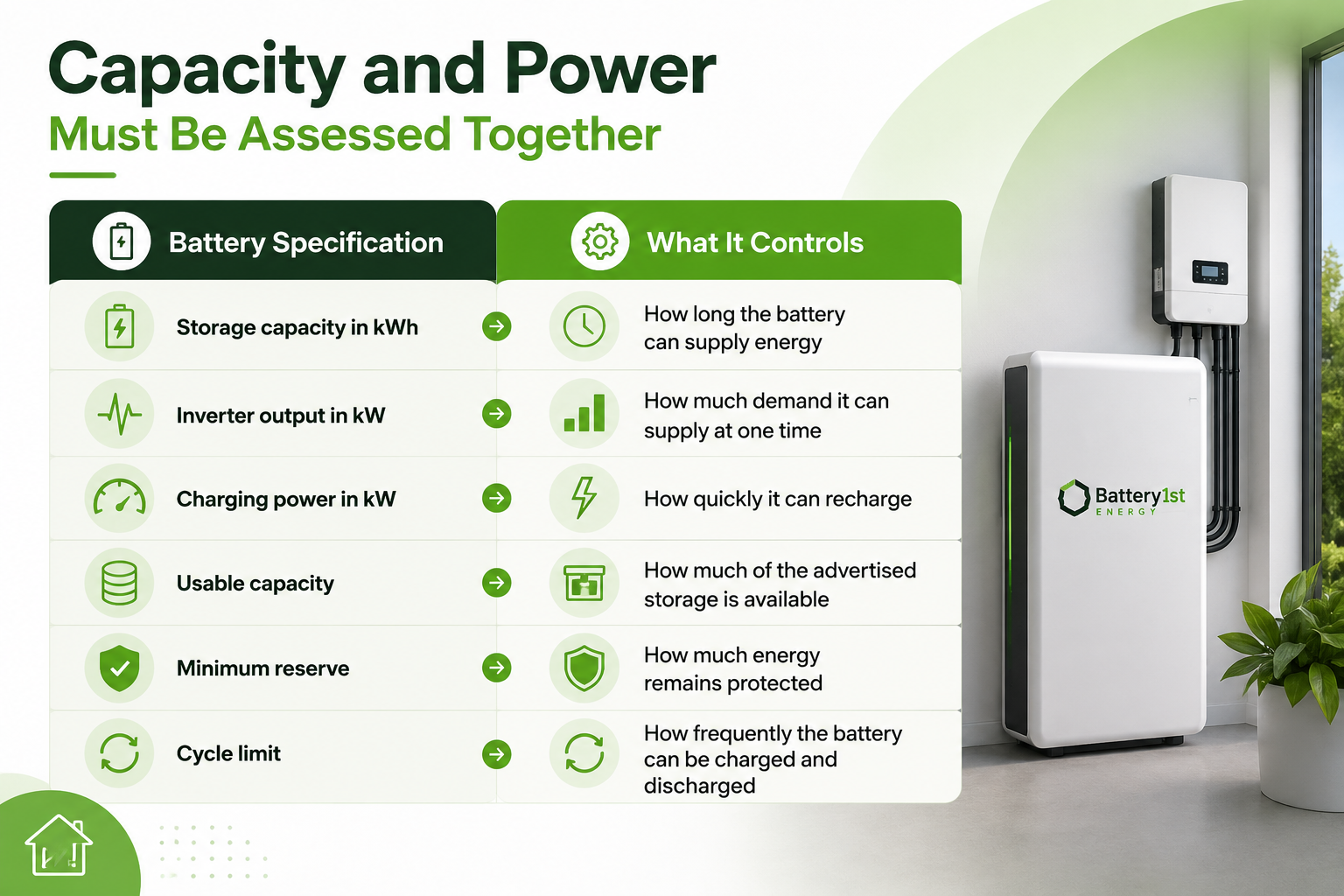
A correctly sized battery must have both sufficient capacity and sufficient power.
What Determines the Right Battery Size?
1. Your daily electricity consumption
Start with your annual electricity consumption, which appears on your electricity bill or supplier account.
Use this basic calculation:
Average daily electricity use = annual electricity use ÷ 365
For example:
3,650kWh ÷ 365 = 10kWh per day
This provides a useful starting point, but average daily consumption alone is not enough. Your battery may not need to cover all 10kWh.
The more important figure is how much electricity you use during the periods you want the battery to cover.
2. When you use electricity
Two homes using 4,000kWh per year could require very different battery sizes.
Household A may use most of its electricity during the evening peak.
Household B may use most of its electricity overnight on a cheap tariff.
Household A may benefit from a larger battery because more expensive consumption can be shifted. Household B may require less battery capacity because much of its consumption already occurs during the lowest-cost period.
Half-hourly smart-meter data provides the clearest picture.
3. Your target coverage
You do not always need to cover 100% of expensive-period demand.
A smaller battery may cover the most valuable part of your consumption at a lower installation cost.
Possible targets include:
50% of peak-period use
75% of peak-period use
90% of peak-period use
100% of normal peak-period use
100% plus an emergency reserve
The most financially efficient size is often the battery that is used regularly rather than one that remains partly unused for much of the year.
4. Usable versus nominal capacity
The advertised battery capacity may be its nominal or total capacity.
However, some energy may be unavailable because the system protects the battery from being fully discharged.
For example:
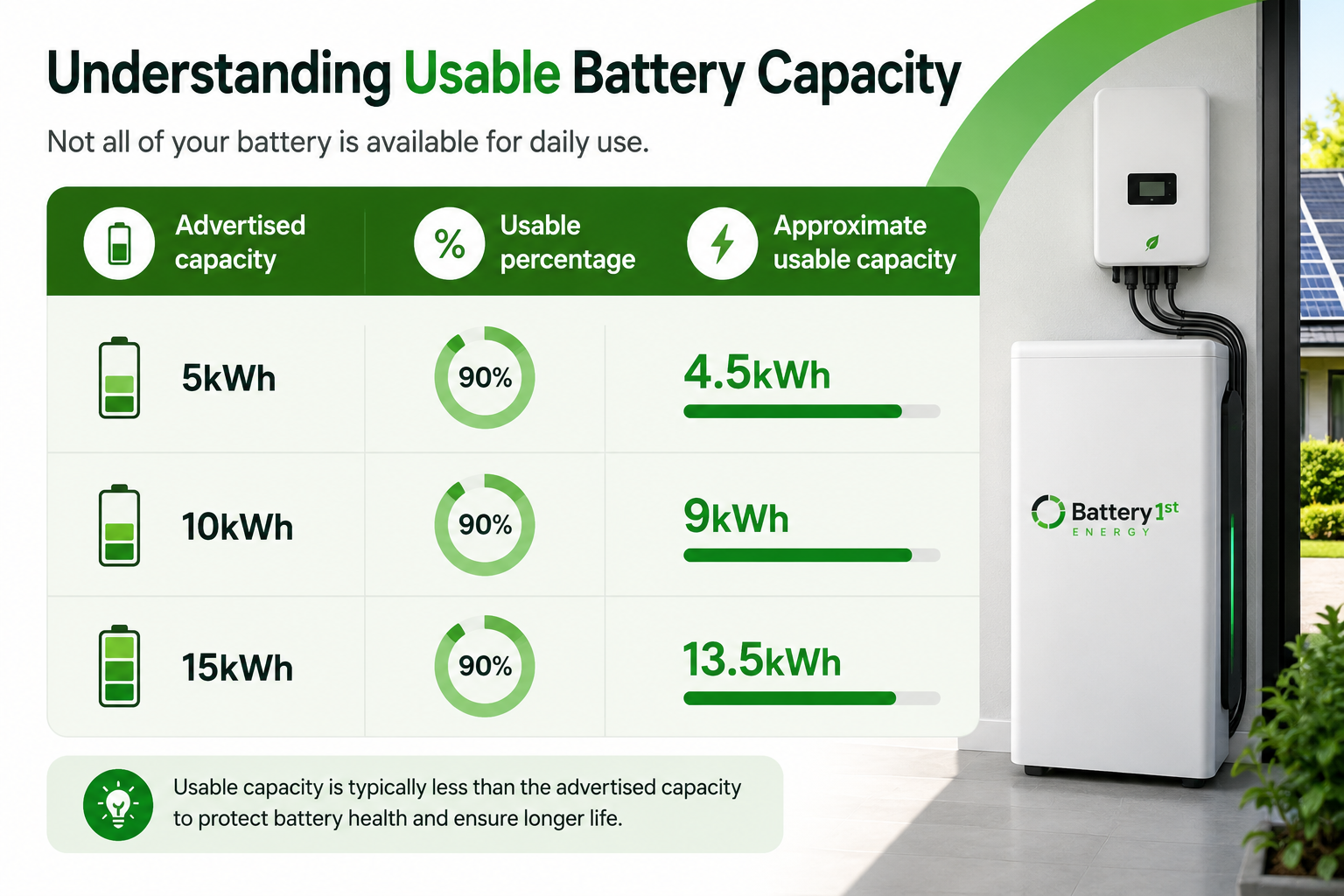
Always compare products using usable capacity rather than relying only on the headline figure.
Energy Saving Trust notes that a battery may stop discharging when it reaches a protected minimum level, such as 20%, because repeatedly discharging to zero can shorten battery life.
5. Charging and discharging losses
Some energy is lost when electricity is converted, stored and discharged.
This means a battery may need to import more than 10kWh to deliver 10kWh to the home.
Battery efficiency varies by:
Battery chemistry
Inverter design
Charging power
Discharge power
Temperature
State of charge
System age
Using stored energy is less efficient than using electricity directly because some energy is lost during storage and conversion.
6. Your tariff structure
A battery charged from the grid must be able to store enough energy during the available cheap electricity window.
Important tariff factors include:
Off-peak rate
Peak rate
Number of cheap charging hours
Whether prices change daily
Standing charge
Export rate
Tariff eligibility
Smart-meter compatibility
A cheap rate that lasts five hours provides more charging time than one that lasts only two hours.
7. Future household electrification
The home battery size you need today may not be the size you need in three years.
Consider whether you may add:
Solar panels
An EV charger
A heat pump
Electric water heating
Air conditioning
A home extension
A garden office
Additional family members
Backup-power capability
A modular system can allow additional battery storage capacity to be installed later, subject to product compatibility, system design and manufacturer requirements.
Home Battery Capacity Calculator
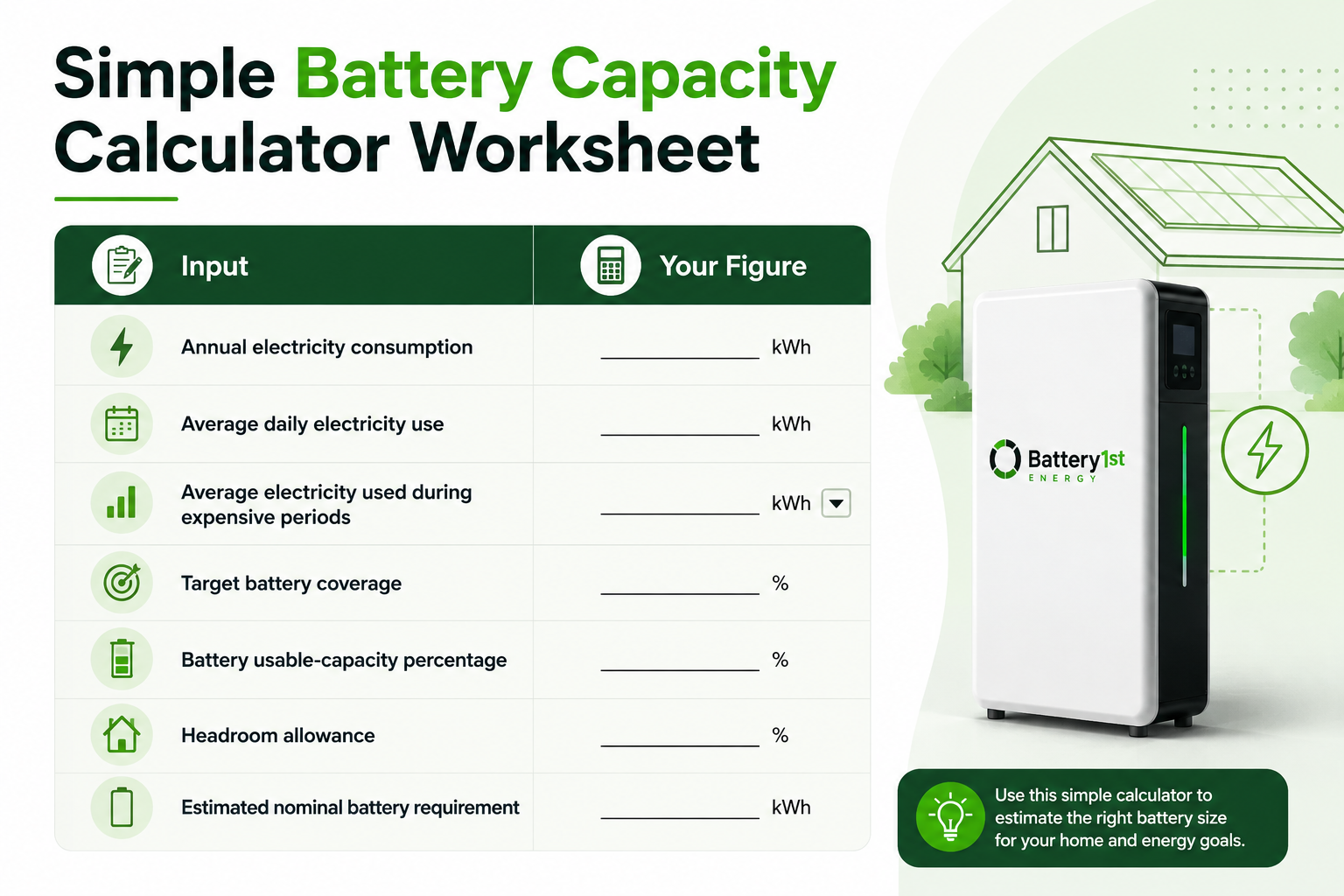
You can create a basic battery capacity calculator using your smart-meter data.
Battery capacity calculator formula
Use the following formula:
Recommended nominal battery capacity =
Average daily energy to shift × target coverage ÷ usable capacity percentage × headroom factor
Where:
Average daily energy to shift is the electricity used during the period the battery should cover.
Target coverage is the percentage of that electricity you want the battery to replace.
Usable capacity percentage is the proportion of total battery capacity available.
Headroom factor provides a buffer for changing demand and normal variation.
A typical headroom factor for an initial calculation might be between 1.10 and 1.20.
Worked battery sizing example
Assume that your household uses an average of 7kWh during expensive periods.
You want the battery to cover 90% of that demand.
The proposed battery allows 90% of its nominal capacity to be used.
You also want 10% headroom.
Step 1: Calculate target energy
7kWh × 90% = 6.3kWh
Step 2: Account for usable capacity
6.3kWh ÷ 90% = 7kWh
Step 3: Add headroom
7kWh × 1.10 = 7.7kWh
A battery with approximately 8kWh of nominal capacity would therefore be a sensible starting point for a professional assessment.
The installer should then verify:
Whether the battery can recharge during the cheap period
Whether its inverter can meet peak household demand
Whether winter consumption requires more capacity
Whether a backup reserve is required
Whether future technologies will be added
Do not size a battery from annual use aloneDividing annual consumption by 365 is useful, but it can overstate or understate the required battery storage capacity.
For a battery-first tariff strategy, the key figure is normally:
Electricity consumed outside the cheap charging period that could realistically be supplied by the battery.
For solar self-consumption, the key figures are:
Surplus solar generation available for storage and electricity used after solar output falls.
Indicative Home Battery Size Ranges
The following home battery size ranges can help homeowners prepare for an installer consultation.
They should not replace a detailed survey.
3–5kWh battery
A smaller 3–5kWh battery may suit:
Low-consumption homes
One- or two-person households
Flats or small properties
Homes shifting a limited evening load
Homes with small solar arrays
Households seeking partial peak-period coverage
It may not be sufficient for homes with high evening demand, electric heating or a heat pump.
5–8kWh battery
A 5–8kWh battery may suit:
Moderate electricity consumption
Smaller family homes
Households using 4–7kWh outside off-peak hours
Homes seeking evening tariff savings
Properties with moderate solar surplus
Households planning limited future electrification
A 5kWh battery can be useful, but it may empty quickly if cooking, laundry and other high-demand appliances operate simultaneously.
8–12kWh battery
An 8–12kWh battery may suit:
Medium-consumption family homes
Households with significant evening demand
Homes on time-of-use tariffs
Homes with larger solar systems
Properties preparing for a heat pump
Households requiring a modest backup reserve
Energy Saving Trust describes approximately 10kWh as a possible typical home battery system size, although actual requirements differ between properties.
12–18kWh battery
A 12–18kWh battery may suit:
Higher-consumption homes
Larger families
Properties with electric heating
Homes with substantial solar generation
Households requiring longer peak-period coverage
Properties combining a battery, heat pump and other electric loads
Homes seeking greater backup capability
The installation must still be checked for charging speed, inverter output and network requirements.
More than 18kWh
A battery above 18kWh may be appropriate for:
Very high electricity consumption
Large detached homes
Electrically heated properties
Multiple buildings
Extended backup requirements
High-capacity solar systems
Complex smart-energy installations
At this level, the project requires detailed load modelling. Simply increasing the battery size may not solve limitations involving inverter power, grid connection capacity or charging time.
Battery Sizing for Off-Peak Tariffs
Battery 1st Energy begins with a battery-led approach. The system stores cheaper off-peak electricity and powers the home later when electricity prices are higher.
For this strategy, the ideal battery capacity is closely linked to the tariff window.
Calculate the energy used outside the cheap period
Suppose a household uses:
2kWh during the off-peak window
8kWh during the remaining hours
The battery does not need to replace the 2kWh already purchased at the cheapest rate. Its main job is to cover as much of the remaining 8kWh as is commercially sensible.
Check whether the battery can recharge in time
Use this formula:
Required average charging power = energy required ÷ charging-window duration
For example, to place 10kWh into a battery during a five-hour off-peak window:
10kWh ÷ 5 hours = 2kW
The real charging requirement will be slightly higher after allowing for losses.
A system with a maximum battery charging power of 3kW may be capable of completing the charge. However, available household supply, other overnight loads and product settings must also be considered.
Account for dynamic tariffs
On a dynamic time-of-use tariff, the cheapest hours may change daily.
A smart energy management system can use tariff prices, household demand, battery charge and future consumption forecasts to decide when and how much to charge.
Battery 1st Energy uses AI-led optimisation to continually adjust battery charging and household energy use. The objective is to improve savings without requiring the homeowner to manually change the battery schedule whenever prices or usage patterns change.
Battery Sizing With Solar Panels
A battery-first system can operate without solar panels, but solar can be added later.
When solar is present, the battery has two possible charging sources:
Surplus solar electricity
Lower-cost grid electricity
Match the battery to solar surplus
Suppose a solar system exports an average of 5kWh on a suitable day.
Installing a 15kWh battery solely to capture that surplus may leave much of the battery unused unless it can also charge from the grid or support additional demand.
Review:
Annual solar generation
Monthly solar generation
Daytime household consumption
Average exported electricity
Evening consumption
Export tariff value
Winter solar performance
Do not use summer generation as the only reference
A battery may fill easily during long summer days but receive much less solar energy during winter.
The best solar-battery size should be tested across several seasons.
Consider export value
Under the Smart Export Guarantee, eligible small-scale renewable generators in Great Britain can receive payment for electricity exported to the grid. Suppliers set their own SEG rates, contract lengths and terms.
When sizing the battery, compare:
The value of storing solar electricity for later use
The value of exporting it
Battery losses
Battery cycling
Future tariff changes
Storing every available unit is not always the most valuable option.
Battery Sizing for an EV or Heat PumpWhat size battery do I need if I own an EV?
An electric vehicle can greatly increase annual electricity consumption, but you do not normally need to size the home battery to charge the entire EV.
Where possible, the EV should usually charge directly from the grid during the cheap tariff period. Passing electricity through the home battery before charging the vehicle introduces additional conversion losses and uses battery cycles.
When planning a battery and EV together, assess:
EV charging times
Daily driving distance
Off-peak tariff duration
EV charger power
Home battery charging power
Property supply capacity
Household demand during EV charging
Whether the battery should support the home while the EV charges
The battery may need to cover household demand outside the cheap window, while the EV charges directly during off-peak hours.
What size battery do I need with a heat pump?
A heat pump can operate for long periods, particularly during cold weather.
Do not size the battery using the heat pump’s thermal output. Use its expected electrical consumption.
Review:
Hourly heat-pump electricity demand
Winter design conditions
Property heat loss
Flow temperature
Heating schedule
Hot-water demand
Tariff periods
Available battery charging time
Other household loads
Energy Saving Trust notes that batteries can be combined with heat pumps and smart time-of-use tariffs to move electricity use into cheaper periods.
A battery may not need to run the heat pump for the entire day. It may be sized to reduce demand during the most expensive tariff window.
Battery Sizing for Backup Power
Backup sizing is different from bill-saving battery sizing.
For bill savings, you size the battery around expensive consumption.
For backup, you size it around:
Essential appliances
Average essential-load power
Required backup duration
Starting power
Battery reserve
Inverter output
Whether solar can recharge the battery
Backup battery capacity formula
Use this initial formula:
Essential load in kW × required hours = required usable energy in kWh
Then account for reserve and system losses.
Backup sizing example
Suppose you want to support:
Fridge and freezer
Internet router
Basic lighting
Phone charging
Selected sockets
Assume the average combined load is 0.6kW and you want eight hours of backup.
0.6kW × 8 hours = 4.8kWh
After adding reserve and headroom, a battery with approximately 6kWh or more may be required.
This does not mean every 6kWh battery can provide backup. The installation must include a compatible inverter, changeover equipment and protected circuits.
A standard grid-connected battery may shut down during a power cut unless backup operation has been designed into the installation.
Whole-home backup requires detailed modelling
Whole-home backup may involve:
Electric ovens
Kettles
Heat pumps
Electric showers
EV chargers
Induction hobs
Pumps
Workshop equipment
The combined power demand can exceed the battery inverter’s output even when sufficient stored capacity remains.
How to Avoid an Oversized or Undersized Battery
Signs that a battery may be too small
A battery may be undersized if it:
Empties early every day
Cannot cover the full expensive tariff period
Leaves significant peak electricity imports
Cannot support normal evening demand
Requires frequent peak-rate top-ups
Has insufficient capacity for planned future loads
A small battery can still be financially effective if it is intentionally designed to cover only the most expensive hours.
Signs that a battery may be too large
A battery may be oversized if it:
Rarely reaches a full charge
Regularly ends the day with substantial unused energy
Cannot charge completely during the off-peak window
Stores more solar energy than the home can use
Adds significant cost without proportional savings
Cycles only a small percentage of its capacity
Oversizing may extend flexibility, but that flexibility must have a clear purpose.
Consider modular expansion
A modular battery installation can reduce the risk of oversizing today.
You may begin with a smaller battery storage capacity and add compatible modules later when:
An EV is purchased
A heat pump is installed
Solar panels are added
Electricity consumption increases
Backup requirements change
Before selecting a modular system, check:
Maximum supported capacity
Whether old and new battery modules can be mixed
Expansion time limits
Warranty conditions
Inverter compatibility
Software licensing
Installation costs for later expansion
Battery Installation Considerations in the UK
Battery sizing is only one part of a successful installation.
Professional property assessment
A suitable survey should examine:
Smart-meter consumption data
Consumer unit condition
Available supply capacity
Earthing arrangements
Cable routes
Proposed battery location
Ventilation requirements
Fire-safety considerations
Internet connectivity
Existing solar or inverter equipment
DNO requirements
Future technologies
DNO notification or approval
A grid-connected battery interacts with the local electricity network.
The UK government advises that either the homeowner or installer will need to inform the relevant Distribution Network Operator when a battery system connects to the grid. Planning permission is not generally required, although homeowners should check with their local planning authority.
Energy Networks Association guidance uses the G98 and G99 connection frameworks for electricity storage and other distributed generation technologies. The correct route depends on the system design and connection characteristics.
Your installer should explain:
Whether prior approval is needed
Whether notification can happen after installation
Which connection process applies
Whether export must be limited
Who will submit the required documents
MCS-certified installation
Energy Saving Trust recommends obtaining at least three quotes from experienced MCS-certified installers.
Using an appropriately qualified installer can also be important for:
Installation quality
Product warranties
Consumer protection
Export tariff eligibility
Documentation
System commissioning
Future property sale records
Installation location
Depending on the product and manufacturer requirements, batteries may be installed in locations such as:
Garages
Utility rooms
Approved external walls
Purpose-designed enclosures
Energy Saving Trust states that location options depend on the battery model and installation circumstances.
The location must account for:
Manufacturer temperature limits
Moisture exposure
Direct sunlight
Flood risk
Access for maintenance
Impact protection
Cable distance
Fire-safety guidance
Wi-Fi or communications signal
UK VAT treatment
Qualifying standalone residential battery installations can currently receive temporary zero-rate VAT treatment. Current government guidance states that the temporary zero rate runs until 31 March 2027, subject to the applicable eligibility rules.
Homeowners should confirm the tax treatment in their written quotation because rules can change.
How Battery 1st Energy Approaches Battery Sizing
Battery 1st Energy helps homeowners reduce electricity bills by beginning with smart battery storage rather than requiring solar panels first.
The process should consider:
Current electricity consumption
Half-hourly usage patterns
Available off-peak tariffs
Electricity used during expensive periods
Required battery charging speed
Usable battery capacity
Inverter power
Future solar plans
EV or heat-pump plans
Backup requirements
The company’s AI continuously optimises charging and battery use to help the system respond to changing tariffs and household demand.
This future-ready approach allows homeowners to start saving with a battery today while retaining the option to add solar panels, EV charging or a heat pump later.
Questions to Ask a Battery Installer
Before accepting a battery installation UK proposal, ask the installer:
What smart-meter data did you use?
How much electricity am I trying to shift each day?
Is the quoted capacity nominal or usable?
What minimum battery reserve is assumed?
What is the maximum continuous inverter output?
What is the short-term peak output?
Can the battery recharge within my off-peak tariff window?
What round-trip efficiency was used in the savings estimate?
What happens when the battery is empty?
Is backup power included?
Which circuits will operate during a power cut?
Can the battery capacity be expanded later?
Can solar panels be added later?
Can the system coordinate with an EV charger or heat pump?
Who handles the DNO application or notification?
Is the installation MCS certified?
What warranty limits apply?
Are there cycle or energy-throughput limits?
What happens if I change energy tariff?
How does the system optimise charging automatically?
A professional recommendation should clearly explain why a particular battery size has been selected.
Conclusion
The answer to “What size home battery do I need UK?” depends on the energy you want the battery to supply—not simply the size of your property.
Begin by measuring how much electricity you use during expensive tariff periods. Then account for target coverage, usable battery capacity, charging losses, reserve requirements and future energy plans.
For many homes, the initial assessment may fall somewhere between 5kWh and 15kWh. However, a smaller or larger system may be more appropriate depending on:
Off-peak electricity availability
Evening consumption
Solar generation
Heat-pump demand
EV charging
Backup requirements
Inverter power
Future expansion
A well-sized battery should charge reliably during cheaper periods, supply enough household demand when prices rise and be used regularly enough to support the financial case.
Battery 1st Energy assesses your household usage and helps identify a suitable smart home battery system. Its battery-first approach allows you to start with off-peak energy savings and add solar panels, EV charging or a heat pump when you are ready.
Check whether your home may qualify and explore a battery system sized around your actual energy use: Complete the Battery 1st Energy home assessment.

A better way to think about home energy
Most homeowners have been taught to think about energy in only one direction: buy from the grid and use it.
Battery First changes that.
Your home can become more active. It can buy power more intelligently. It can keep free generation for later. And in the right setup, it can sell energy back when the grid needs support.
That is a fundamentally better energy position than simply being a passive bill payer.


Buy electricity smarter. Store it. Use it. And when the time is right, sell it back.


Quick links
Other
© Battery 1st Energy. 2026. All Rights Reserved.